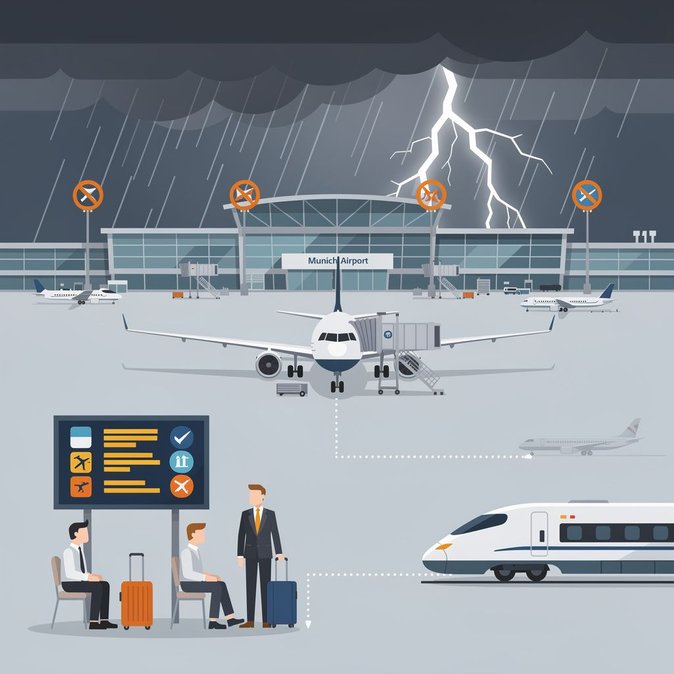
Munich Airport suspended all passenger handling on the morning of 1 July after meteorologists issued an extreme-thunderstorm warning for the wider Bavarian region. The shutdown – announced over terminal loudspeakers – led to the cancellation of at least one return rotation on the busy Munich–Prague route, with further disruptions likely as airlines reposition aircraft. Prague’s Václav Havel Airport reported the immediate scrubbing of the 12:40 arrival and 13:20 departure operated by Lufthansa CityLine, advising passengers to monitor flight-status updates.
For travellers suddenly forced to reroute or secure additional travel documents at short notice, VisaHQ can simplify the process with an online platform that handles visa requirements, passport renewals and transit queries for Czech and international passengers alike. Its step-by-step tools and courier options help cut down administrative lead times when connections shift to alternate hubs such as Zurich or Amsterdam — more information is available at https://www.visahq.com/czech-republic/
Industry analysts note that the 340-kilometre hop is a critical feeder for inter-continental connections, especially for Czech executives heading to Asia-Pacific via Munich. Any prolonged closure could trigger a spike in rail bookings on the four-hour Prague–Munich service and on alternative flights through Frankfurt or Vienna. Beyond today’s weather chaos, the incident underscores the vulnerability of Central Europe’s tightly meshed short-haul network to climate-related disruptions. Airlines have begun revising their ‘irregular-ops’ playbooks to prioritise cross-border coaches and high-speed rail charters when adjoining hubs are affected by extreme weather. Czech corporates with time-sensitive shipments – such as automotive prototypes – may need to activate contingency couriers through road freight corridors. Travel-management companies recommend that Czech business travellers build at least a three-hour buffer when connecting through Munich during the current storm season and consider flexible tickets that allow re-routing via Zurich or Amsterdam. Employers should also remind staff that EU Regulation 261 compensation does not apply when cancellations are caused by extraordinary weather events, meaning additional hotel and subsistence costs will fall to the traveller or the company.
For travellers suddenly forced to reroute or secure additional travel documents at short notice, VisaHQ can simplify the process with an online platform that handles visa requirements, passport renewals and transit queries for Czech and international passengers alike. Its step-by-step tools and courier options help cut down administrative lead times when connections shift to alternate hubs such as Zurich or Amsterdam — more information is available at https://www.visahq.com/czech-republic/
Industry analysts note that the 340-kilometre hop is a critical feeder for inter-continental connections, especially for Czech executives heading to Asia-Pacific via Munich. Any prolonged closure could trigger a spike in rail bookings on the four-hour Prague–Munich service and on alternative flights through Frankfurt or Vienna. Beyond today’s weather chaos, the incident underscores the vulnerability of Central Europe’s tightly meshed short-haul network to climate-related disruptions. Airlines have begun revising their ‘irregular-ops’ playbooks to prioritise cross-border coaches and high-speed rail charters when adjoining hubs are affected by extreme weather. Czech corporates with time-sensitive shipments – such as automotive prototypes – may need to activate contingency couriers through road freight corridors. Travel-management companies recommend that Czech business travellers build at least a three-hour buffer when connecting through Munich during the current storm season and consider flexible tickets that allow re-routing via Zurich or Amsterdam. Employers should also remind staff that EU Regulation 261 compensation does not apply when cancellations are caused by extraordinary weather events, meaning additional hotel and subsistence costs will fall to the traveller or the company.