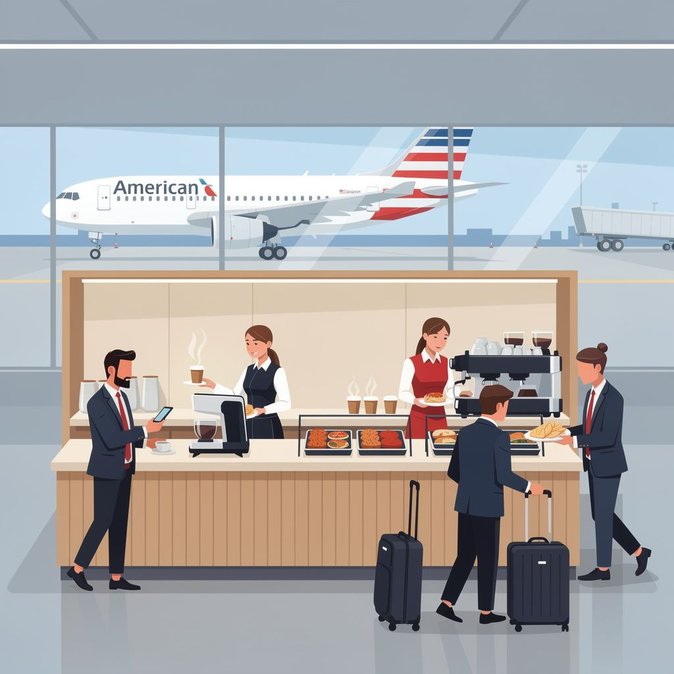
American Airlines opened the doors today to its second—and significantly larger—“Provisions by Admirals Club” lounge at New York’s John F. Kennedy Airport. The 3,700-square-foot space in Terminal 8, Concourse B, introduces the carrier’s first dedicated barista bar and a hot-food program aimed at hurried flyers who lack time for a traditional sit-down lounge visit. Unlike American’s flagship lounges, Provisions is designed for speed: guests swipe in, grab fresh meals or barista-made Lavazza coffee, and exit within minutes.
Before savoring a barista-made cappuccino, however, international flyers should confirm their entry documentation is in order. VisaHQ’s online platform (https://www.visahq.com/united-states/) streamlines visa and passport services for U.S. travelers, offering real-time requirement checks, digital application kits, and optional courier support—so the only queue you worry about at JFK is for your flat white.
The model debuted in 2025 at Charlotte but has been upgraded in both size and amenities for the New York market, where tight connection windows and construction at neighboring gates often leave little dwell time. Access rules mirror standard Admirals Club entry—annual membership, eligible AAdvantage credit cards, or a $79 one-day pass—but capacity is capped at 120 guests to keep queues short. American says the concept targets “micro-dwell” travelers, a segment that consultancy IdeaWorks pegs at 28 percent of premium passengers at hub airports. The carrier hopes to divert through-traffic from its crowded Concourse C lounge, improving conditions for longer-stay customers. For companies with negotiated Admirals Club memberships or Citi / AAdvantage Executive card benefits, the JFK opening expands lounge coverage to more gates, potentially shortening connection-risk buffers. Travel managers should update lounge locator tools and brief frequent travelers that hot breakfast items are available only until 11 a.m.; vegetarian options run all day. American’s rivals are responding: Delta has confirmed Sky Club “Express” prototypes for Atlanta by year-end, while United is scouting additional Club Fly sites beyond Denver and Houston. The competition underscores how lounge access—once a static perk—has become a dynamic part of the door-to-door journey that global mobility programs must factor into traveler experience and productivity.
Before savoring a barista-made cappuccino, however, international flyers should confirm their entry documentation is in order. VisaHQ’s online platform (https://www.visahq.com/united-states/) streamlines visa and passport services for U.S. travelers, offering real-time requirement checks, digital application kits, and optional courier support—so the only queue you worry about at JFK is for your flat white.
The model debuted in 2025 at Charlotte but has been upgraded in both size and amenities for the New York market, where tight connection windows and construction at neighboring gates often leave little dwell time. Access rules mirror standard Admirals Club entry—annual membership, eligible AAdvantage credit cards, or a $79 one-day pass—but capacity is capped at 120 guests to keep queues short. American says the concept targets “micro-dwell” travelers, a segment that consultancy IdeaWorks pegs at 28 percent of premium passengers at hub airports. The carrier hopes to divert through-traffic from its crowded Concourse C lounge, improving conditions for longer-stay customers. For companies with negotiated Admirals Club memberships or Citi / AAdvantage Executive card benefits, the JFK opening expands lounge coverage to more gates, potentially shortening connection-risk buffers. Travel managers should update lounge locator tools and brief frequent travelers that hot breakfast items are available only until 11 a.m.; vegetarian options run all day. American’s rivals are responding: Delta has confirmed Sky Club “Express” prototypes for Atlanta by year-end, while United is scouting additional Club Fly sites beyond Denver and Houston. The competition underscores how lounge access—once a static perk—has become a dynamic part of the door-to-door journey that global mobility programs must factor into traveler experience and productivity.