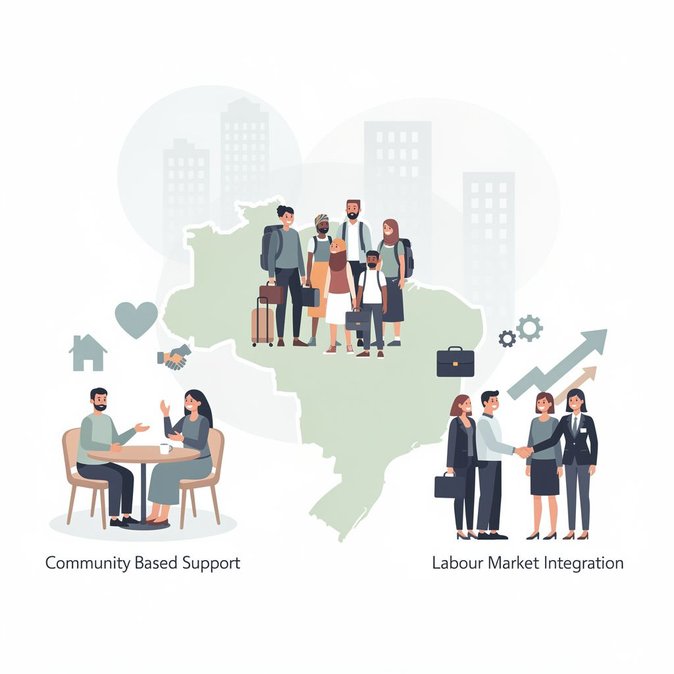
Brazil’s Ministry of Justice and Public Security (MJSP) opened its third Capacity-Building Workshop for Civil-Society Organisations (CSOs) in Brasília on 1 July, marking a new phase of the National Humanitarian Reception Programme through Community Sponsorship. Developed with UNHCR, IOM and the NGO Pathways International, the initiative operationalises Portaria 1.242/2026, which formally embedded community sponsorship into Brazil’s National Migration, Refuge and Statelessness Policy last month. Under the model, vetted CSOs receive government funding and technical guidance to assist refugees and humanitarian-visa holders—currently focused on Afghans and stateless persons—from the moment they board flights to their integration into Brazilian communities. The training covers pre-departure orientation, airport reception, documentation with the Federal Police, Portuguese classes, job placement and long-term mentoring.
![Justice Ministry Trains NGOs for Brazil’s Community-Sponsorship Refugee Programme]()
For organisations and individuals navigating the paperwork associated with these humanitarian visas, VisaHQ can streamline the process. Its online platform (https://www.visahq.com/brazil/) centralises document checklists, appointment booking and status tracking, giving sponsors and employers real-time visibility while reducing administrative bottlenecks.
Officials say the scheme responds to lessons learned from Operação Acolhida, Brazil’s large-scale reception of Venezuelans in Roraima, but shifts emphasis from emergency shelters to community participation and private sponsorship. “We want refugees to arrive with a support network already in place so they can move straight into regular housing and employment,” explained migration-department director Victor Semple. For employers, the programme creates a single point of contact to source work-authorised talent with language and cultural-adaptation support, reducing onboarding costs. It also aligns with ESG targets: participating firms can count sponsorship outlays toward social-impact metrics under Brazil’s new Sustainable Business Reporting standard. Mobility managers should note that humanitarian visa holders are granted an automatic two-year work authorisation, renewable for permanent residence after four years. MJSP will publish updated implementation guidelines on 15 July and is seeking additional CSO partners in São Paulo, Curitiba and Porto Alegre. Companies interested in acting as local mentors can register through the ministry’s MigranteWeb portal. The government ultimately hopes to triple annual community-sponsorship arrivals to 9,000 by 2028, diversifying beyond the Venezuelan-centric profile of recent years.

For organisations and individuals navigating the paperwork associated with these humanitarian visas, VisaHQ can streamline the process. Its online platform (https://www.visahq.com/brazil/) centralises document checklists, appointment booking and status tracking, giving sponsors and employers real-time visibility while reducing administrative bottlenecks.
Officials say the scheme responds to lessons learned from Operação Acolhida, Brazil’s large-scale reception of Venezuelans in Roraima, but shifts emphasis from emergency shelters to community participation and private sponsorship. “We want refugees to arrive with a support network already in place so they can move straight into regular housing and employment,” explained migration-department director Victor Semple. For employers, the programme creates a single point of contact to source work-authorised talent with language and cultural-adaptation support, reducing onboarding costs. It also aligns with ESG targets: participating firms can count sponsorship outlays toward social-impact metrics under Brazil’s new Sustainable Business Reporting standard. Mobility managers should note that humanitarian visa holders are granted an automatic two-year work authorisation, renewable for permanent residence after four years. MJSP will publish updated implementation guidelines on 15 July and is seeking additional CSO partners in São Paulo, Curitiba and Porto Alegre. Companies interested in acting as local mentors can register through the ministry’s MigranteWeb portal. The government ultimately hopes to triple annual community-sponsorship arrivals to 9,000 by 2028, diversifying beyond the Venezuelan-centric profile of recent years.