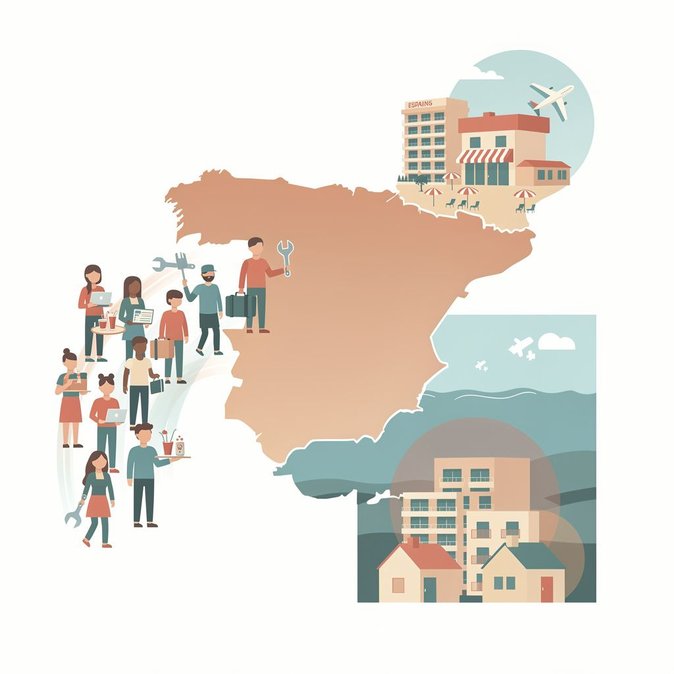
Spain’s extraordinary regularisation programme—open only from 16 April to 30 June—has moved at record speed. The Ministry of Inclusion, Social Security and Migration confirmed on 2 July that 609,737 of the 1.17 million undocumented migrants who submitted applications have already received a one-year, renewable residence-and-work authorisation, giving them immediate access to the formal labour market while their files are examined in detail. The first batch of permits was printed electronically just nine working days after the window closed, reflecting the ministry’s decision to process files in the order in which biometric data were captured rather than the date of online submission. Officials say 83 % of all applications were lodged online, a proportion comparable with Spain’s standard extranjería procedures. Most applicants come from Latin America—Colombia (26 %), Venezuela (11.7 %), and Peru (8.8 %) lead the list—followed by Morocco (13.4 %). A voluntary questionnaire sent to 161,000 early filers suggests that 43 % have completed upper-secondary or vocational training and 24 % hold university degrees, data the government plans to use to match skills to regional labour shortages. For employers, the new permits remove the sponsorship burden that normally attaches to initial hires of non-EU nationals. Holders can accept any job offer in Spain without labour-market testing, provided the contract carries at least the statutory minimum wage (€1,425 gross per month in 2026). This is already easing staffing gaps in tourism, agrifood logistics and elder-care—sectors reporting record demand at the height of the summer season. The regularisation is also reshaping Spain’s social-security balance sheet. In June alone, foreign labour pushed total affiliation to an all-time high of 22.46 million workers; nearly 87,000 of those additional contributors were non-Spanish nationals. The ministry estimates that each 100,000 newly regularised employees generate roughly €250 million in annual payroll taxes and cut undeclared‐work losses by a similar amount, helping shore up pension finances as Spain’s population ages. While business associations have welcomed the measure, the opposition Partido Popular argues that the government has offered “an amnesty without integration resources”, warning of pressures on housing and public services. The ministry counters that regularisation is a pre-condition for inclusion and points to a €1.2 billion Integration and Citizenship Plan—approved on 30 June—that channels EU and national funds into language training, credential recognition and affordable rental schemes for newcomers. For corporates with mobile workforces, the message is clear: Spain is positioning itself as one of the EU’s most open large economies for low- and middle-skilled migrants, at least for the next 12 months.