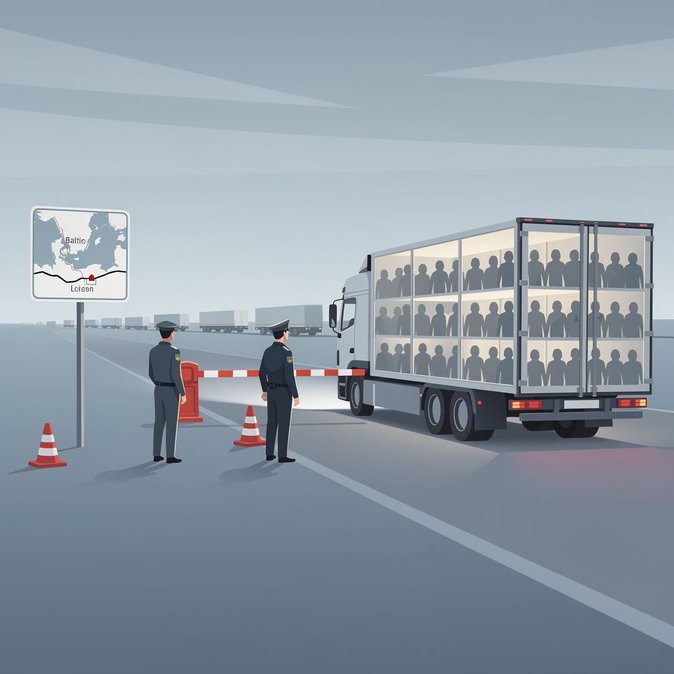
Poland’s eastern flank was again at the centre of Europe’s migration debate on 3 July when officers from the Podlaskie Border Guard, assisted by Customs officials, discovered 54 irregular migrants hidden in the sealed trailer of a Romanian-registered lorry at the Budzisko checkpoint on the Lithuanian border. According to the Border Guard communiqué, the vehicle, driven by a 37-year-old Romanian national, had entered Poland from Latvia and was routed for a secondary inspection after officers noticed discrepancies in the driver’s paperwork and temperature anomalies inside the trailer. When the doors were opened, they found 30 Pakistanis, 15 Afghans and 9 Bangladeshis – all of whom admitted paying smugglers in the Baltic states for transport deeper into the Schengen area. The migrants were provided with water and medical checks before being interviewed. None possessed documents entitling them to enter or remain in Poland, and all were readmitted to Lithuania under the EU’s bilateral readmission procedure. The driver was arrested on suspicion of organising illegal border crossings (Article 264 §3 of Poland’s Penal Code); he faces up to eight years’ imprisonment and vehicle confiscation. For companies moving staff or goods by road through the Baltic–Poland corridor, the case illustrates how intensified checks – introduced in 2025 and recently prolonged – can delay freight movements. Carriers are being advised by trade bodies to factor an extra 1-2 hours into schedules on the Suwałki–Budzisko route and to ensure drivers’ documents match cargo manifests. Employers seconding non-EU nationals through Poland should also expect heightened scrutiny of passports and Schengen visas while the temporary controls remain in force. With Warsaw determined to staunch facilitation networks that move people from Belarus and the Baltic states into Germany, experts expect joint Polish-Lithuanian patrols, sniffer-dog teams and mobile x-ray units at Budzisko and Ogrodniki to remain a fixture through the 2026 summer peak.