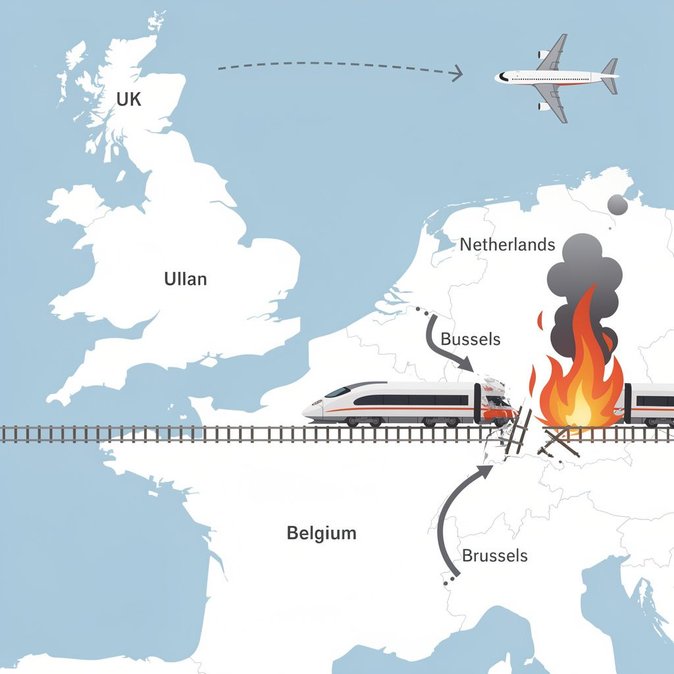
A track-side fire close to Rotterdam Centraal on the evening of 3 July has forced Dutch rail authorities to close a key section of the high-speed line, prompting Eurostar to divert or cancel trains linking London with Rotterdam and Amsterdam. Engineering teams say overhead-cable damage is extensive and through-services cannot resume before late on 4 July.
While travellers juggle revised itineraries, VisaHQ can streamline the paperwork, expediting any last-minute visa or passport renewals that sudden rerouting via third countries might require; its online tools and same-day courier options are built for precisely this kind of unexpected disruption.
Eurostar has invoked its “do not travel” policy for the Netherlands, offering fee-free exchanges or refunds to all passengers booked for 3–4 July. Trains to Brussels are running, but onward connections require a Thalys or a local Sprinter service, both of which are struggling with displaced demand. Average journey times from St Pancras to Amsterdam have stretched from four to almost seven hours. The disruption lands at the height of the UK school-holiday getaway and just weeks before Eurostar suspends its Dutch route entirely for station-upgrade works in August. Corporate travel managers moving staff between UK head offices and Dutch subsidiaries are being advised to route via Schiphol by air or postpone non-essential trips. Eurostar says it will add an extra London–Brussels round-trip on 5 July to clear the backlog, but warns that spontaneous queues at St Pancras are likely. Ticket holders should arrive no more than 60 minutes before departure to avoid crowding in the departure hall, where space is limited due to ongoing security-lane works. Longer term, the incident underscores the vulnerability of cross-Channel rail to single-point failures on mainland infrastructure. Travel-risk teams should factor in alternative routings—Eurotunnel car shuttles, ferries or short-haul flights—when planning urgent mobility moves between the UK and Benelux.
While travellers juggle revised itineraries, VisaHQ can streamline the paperwork, expediting any last-minute visa or passport renewals that sudden rerouting via third countries might require; its online tools and same-day courier options are built for precisely this kind of unexpected disruption.
Eurostar has invoked its “do not travel” policy for the Netherlands, offering fee-free exchanges or refunds to all passengers booked for 3–4 July. Trains to Brussels are running, but onward connections require a Thalys or a local Sprinter service, both of which are struggling with displaced demand. Average journey times from St Pancras to Amsterdam have stretched from four to almost seven hours. The disruption lands at the height of the UK school-holiday getaway and just weeks before Eurostar suspends its Dutch route entirely for station-upgrade works in August. Corporate travel managers moving staff between UK head offices and Dutch subsidiaries are being advised to route via Schiphol by air or postpone non-essential trips. Eurostar says it will add an extra London–Brussels round-trip on 5 July to clear the backlog, but warns that spontaneous queues at St Pancras are likely. Ticket holders should arrive no more than 60 minutes before departure to avoid crowding in the departure hall, where space is limited due to ongoing security-lane works. Longer term, the incident underscores the vulnerability of cross-Channel rail to single-point failures on mainland infrastructure. Travel-risk teams should factor in alternative routings—Eurotunnel car shuttles, ferries or short-haul flights—when planning urgent mobility moves between the UK and Benelux.