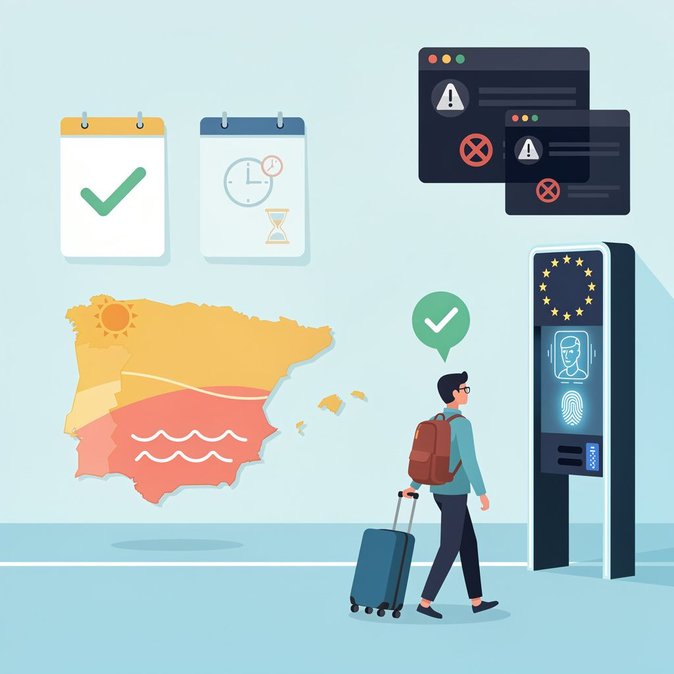
Business travellers heading to Spain this summer can breathe a sigh of relief: despite a flood of social-media posts claiming otherwise, the European Travel Information and Authorisation System (ETIAS) is **not** yet in force. A fresh briefing published on 5 July by visa-document platform PNR Booking clarifies that the online permit will launch in the last quarter of 2026, followed by a grace period of at least six months. Mandatory enforcement is therefore pencilled in for around April 2027. ETIAS is often confused with the EU’s new biometric Entry/Exit System (EES), which has been live since 10 April 2026 and is already causing bottlenecks at Spanish airports. Unlike the EES, ETIAS is a pre-travel authorisation aimed at nationals of 59 visa-exempt countries—including the United States, the United Kingdom and Canada—who currently enter Spain without paperwork. Travellers will complete a short online form, pay a €20 fee (waived for under-18s and over-70s) and receive an approval valid for three years or until their passport expires. For corporations planning meetings, incentives or project work in Spain, the clarification means there is **no new paperwork this summer**. Employees and assignees from visa-exempt countries continue to rely on the standard 90-in-180-day Schengen allowance, plus proof of accommodation, funds and return travel if asked at the border. Companies should, however, start mapping future compliance processes: once ETIAS becomes compulsory, booking engines or TMCs will need to capture employees’ ETIAS numbers alongside passport data. Travel managers should also warn staff about online scams. Scores of unofficial websites are already charging fees for “ETIAS applications” even though the EU’s own portal has not opened. The European Commission has said it will give at least six months’ notice of the exact launch date; until then, any third-party offer to “process” an ETIAS is fraudulent. In the meantime, the real operational threat remains the EES. Airlines and airports are lobbying Brussels for flexibility as fingerprint kiosks struggle with peak-season queues. While ETIAS will eventually streamline pre-travel screening, companies should focus short-term risk-mitigation on extra connection time and digital readiness for EES biometrics rather than chasing a permit that does not yet exist.
Source: PNR Booking