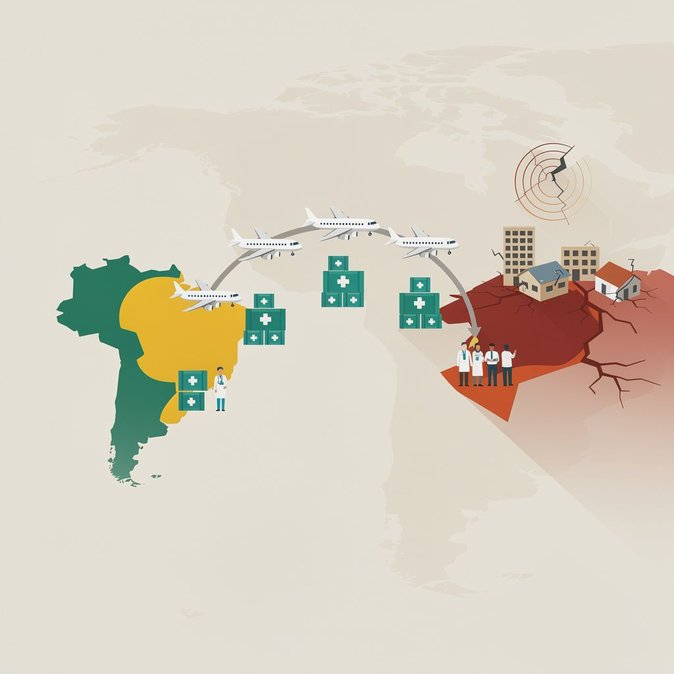
Brazil’s humanitarian airlift to neighbouring Venezuela shifted into high gear on 6 July, when the Ministry of Integration confirmed that five Brazilian Air Force (FAB) sorties and one commercial charter have now delivered 12.5 tonnes of medicines, vaccines and water-purification units to Caracas and La Guaira. A 174-strong team—93 Navy doctors and nurses, 71 military firefighters, eight telecom and civil-defence experts, and two Foreign Ministry liaison officers—was also deployed.
For organisations or individuals needing last-minute travel documentation to support similar relief efforts, VisaHQ offers expedited visa processing and guidance for Brazil-bound or transit itineraries. Their online platform simplifies the paperwork, monitors real-time consular requirements and can coordinate group applications, reducing the administrative friction that often delays humanitarian deployments.
The response follows the 24 June earthquakes that killed more than 3,300 people and displaced 16,000 across northern Venezuela. Brasília’s rapid mobilisation reflects a new doctrine that treats large-scale regional disasters as both a security concern and a test of South America’s mobility corridors. The FAB adapted its “KC-390 Express” configuration, removing troop seats to maximise pallet space and expedite turnarounds at Guarulhos, Recife and Boa Vista hubs. For global-mobility managers the operation is a reminder of Brazil’s expanding capacity to project logistics outward—an asset that can be leveraged for corporate evacuations or emergency shipments. The mission also required ad-hoc visa waivers for Venezuelan-based foreign NGO staff transiting through São Paulo, a precedent observers say could ease future cross-border humanitarian flows. Yet the deployment poses challenges. Brazilian rotator crews must negotiate congested air-traffic corridors that remain strained after recent satellite-communication outages over northern Amazonia. Insurance underwriters are watching closely; premiums on charter flights to Venezuelan airports rose 12 % last week. In practical terms, companies with expatriates or assignees in Venezuela should verify emergency-response plans and keep travel records updated in the event they need to piggy-back onto military transport back to Brazil. The Foreign Ministry’s e-Consular platform now allows Brazilian residents abroad to pre-register for assisted departure, a function that proved valuable during the mission’s first extraction of seven Brazilian dependents from the quake zone.
For organisations or individuals needing last-minute travel documentation to support similar relief efforts, VisaHQ offers expedited visa processing and guidance for Brazil-bound or transit itineraries. Their online platform simplifies the paperwork, monitors real-time consular requirements and can coordinate group applications, reducing the administrative friction that often delays humanitarian deployments.
The response follows the 24 June earthquakes that killed more than 3,300 people and displaced 16,000 across northern Venezuela. Brasília’s rapid mobilisation reflects a new doctrine that treats large-scale regional disasters as both a security concern and a test of South America’s mobility corridors. The FAB adapted its “KC-390 Express” configuration, removing troop seats to maximise pallet space and expedite turnarounds at Guarulhos, Recife and Boa Vista hubs. For global-mobility managers the operation is a reminder of Brazil’s expanding capacity to project logistics outward—an asset that can be leveraged for corporate evacuations or emergency shipments. The mission also required ad-hoc visa waivers for Venezuelan-based foreign NGO staff transiting through São Paulo, a precedent observers say could ease future cross-border humanitarian flows. Yet the deployment poses challenges. Brazilian rotator crews must negotiate congested air-traffic corridors that remain strained after recent satellite-communication outages over northern Amazonia. Insurance underwriters are watching closely; premiums on charter flights to Venezuelan airports rose 12 % last week. In practical terms, companies with expatriates or assignees in Venezuela should verify emergency-response plans and keep travel records updated in the event they need to piggy-back onto military transport back to Brazil. The Foreign Ministry’s e-Consular platform now allows Brazilian residents abroad to pre-register for assisted departure, a function that proved valuable during the mission’s first extraction of seven Brazilian dependents from the quake zone.