Upgraded Points has released a first-of-its-kind deep-dive into Transportation Security Administration checkpoint throughput during the March–May government shutdown that froze TSA paychecks for six weeks.
Travelers worried about facing similar turbulence in future shutdowns should know that VisaHQ can shorten at least one airport line: the document check. The company’s online platform streamlines passport renewals and visa processing for U.S. travelers, providing door-to-door courier service and live status updates so flyers aren’t caught off guard by paperwork snags just as security wait times spike.
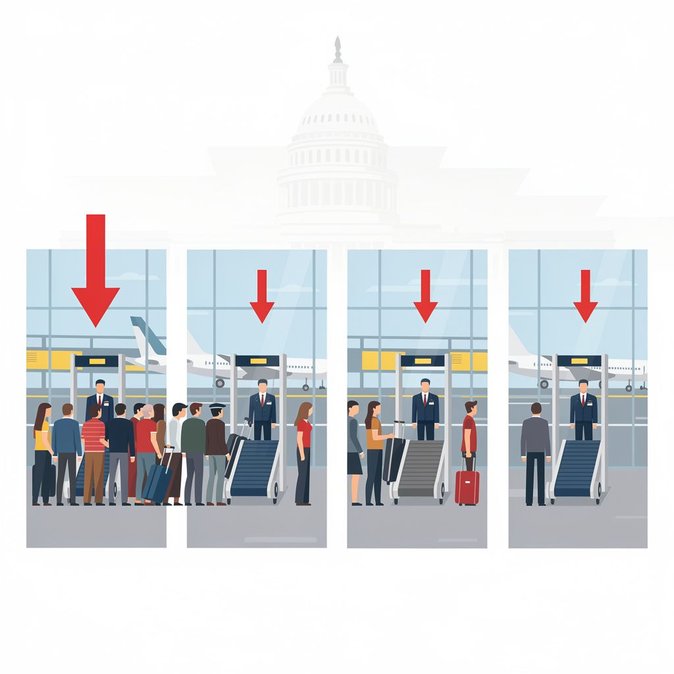
Updated July 7, the analysis reveals a 6.7 % nationwide drop in screenings but eye-popping outliers: Atlanta (ATL) plunged 76.9 %, Boston (BOS) 29.1 % and Miami (MIA) 26.2 %. The variance, analysts say, reflects how uneven local cost-of-living pressures drove TSOs to call in sick or resign. Chicago O’Hare bucked the trend with an 8.7 % increase, thanks to a lower 13.8 % callout rate versus 28 % at nearby JFK. ICE officers were even drafted to ATL security lanes—an extraordinary measure that created its own civil-liberties concerns. Beyond the headlines, the report quantifies downstream business costs: reduced throughput translated into a 4-point drop in on-time departures for Fortune 500 corporate shuttle routes and a 6 % surge in last-minute premium-fare purchases as travelers sought to dodge bottlenecks. Airlines absorbed higher crew-repositioning expenses just as inflation-adjusted base fares were falling, squeezing margins. The study matters because Congress is due to debate a FY 2027 DHS appropriations bill this month. If another lapse looms, mobility managers may need to pre-emptively reroute critical travel away from historically vulnerable airports and budget for additional ancillary fees when schedules fracture. For policy advocates, the data provide empirical ammunition to argue that aviation security staffing is not fungible; TSOs are specialized employees whose sudden absence can throttle a $900 billion travel economy within days.
Travelers worried about facing similar turbulence in future shutdowns should know that VisaHQ can shorten at least one airport line: the document check. The company’s online platform streamlines passport renewals and visa processing for U.S. travelers, providing door-to-door courier service and live status updates so flyers aren’t caught off guard by paperwork snags just as security wait times spike.
Updated July 7, the analysis reveals a 6.7 % nationwide drop in screenings but eye-popping outliers: Atlanta (ATL) plunged 76.9 %, Boston (BOS) 29.1 % and Miami (MIA) 26.2 %. The variance, analysts say, reflects how uneven local cost-of-living pressures drove TSOs to call in sick or resign. Chicago O’Hare bucked the trend with an 8.7 % increase, thanks to a lower 13.8 % callout rate versus 28 % at nearby JFK. ICE officers were even drafted to ATL security lanes—an extraordinary measure that created its own civil-liberties concerns. Beyond the headlines, the report quantifies downstream business costs: reduced throughput translated into a 4-point drop in on-time departures for Fortune 500 corporate shuttle routes and a 6 % surge in last-minute premium-fare purchases as travelers sought to dodge bottlenecks. Airlines absorbed higher crew-repositioning expenses just as inflation-adjusted base fares were falling, squeezing margins. The study matters because Congress is due to debate a FY 2027 DHS appropriations bill this month. If another lapse looms, mobility managers may need to pre-emptively reroute critical travel away from historically vulnerable airports and budget for additional ancillary fees when schedules fracture. For policy advocates, the data provide empirical ammunition to argue that aviation security staffing is not fungible; TSOs are specialized employees whose sudden absence can throttle a $900 billion travel economy within days.