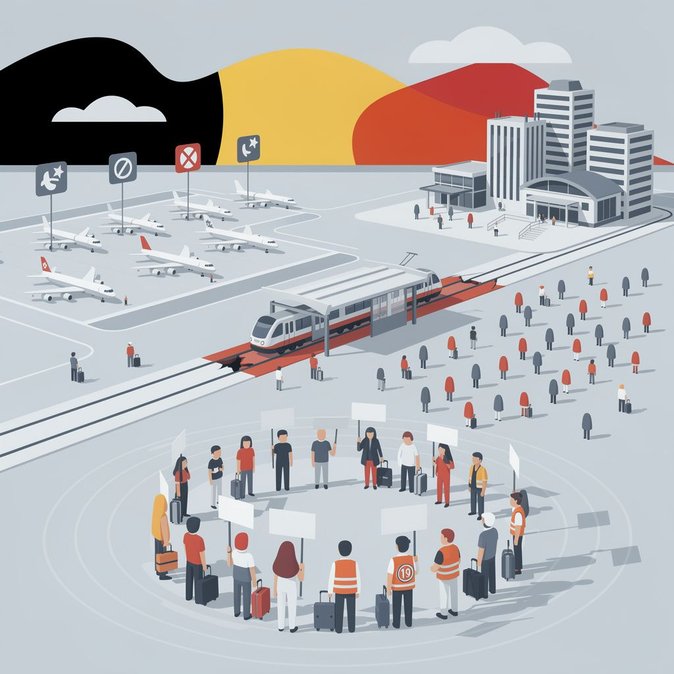
Belgium woke up on 8 July to a coordinated three-day strike led by the country’s three largest union confederations—FGTB/ABVV, CSC/ACV and CGSLB/ACLVB—in protest against proposed salary and pension cuts in the 2027–29 federal budget. AK&M reports that more than 100,000 demonstrators flooded Brussels on the opening day, while pickets formed at Zaventem and Charleroi airports, rail yards and bus depots. At Brussels Airport, several early-morning flights were cancelled or departed without checked luggage after loaders walked off the job. National rail operator SNCB/NMBS ran a skeleton timetable, and Brussels public-transit agency STIB reported intermittent depot blockades. The civil-aviation authority issued NOTAMs warning of potential staffing shortages for air-traffic controllers, although Eurocontrol said en-route flows were so far unaffected.
For travelers whose itineraries are being reshuffled at the last minute, VisaHQ can help streamline any urgent Belgian visa applications or extensions completely online, cutting down the time you need to spend queuing at consulates. Its step-by-step platform lets corporate travel departments and individual passengers track requirements in real time and arrange courier pickups, an advantage when strikes are hampering public transport access to embassies.
The unions accuse Prime Minister Bart De Wever’s coalition of balancing the books on workers’ backs by capping wage-indexation and raising the statutory pension age for certain categories. The government counters that debt levels—now 104.7 % of GDP—leave little alternative. Talks at the National Labour Council broke down last week, clearing the procedural runway for this week’s walk-out. Business-travel managers should expect rolling disruption through 10 July. Eurostar has already warned of delays at Brussels-Midi; several multinational employers in the capital’s EU Quarter have switched to remote-working protocols. Companies moving key staff across Belgium are advised to use taxi or car-service alternatives and to confirm hotel reservations, as housekeeping unions are also participating. While Belgium is no stranger to strike action, the breadth of sectors involved—aviation, rail, healthcare, education and municipal services—marks this as the largest mobilisation since the pandemic. Observers say the confrontation could shape autumn budget negotiations and influence foreign investors assessing Belgium’s labour-relations climate.
For travelers whose itineraries are being reshuffled at the last minute, VisaHQ can help streamline any urgent Belgian visa applications or extensions completely online, cutting down the time you need to spend queuing at consulates. Its step-by-step platform lets corporate travel departments and individual passengers track requirements in real time and arrange courier pickups, an advantage when strikes are hampering public transport access to embassies.
The unions accuse Prime Minister Bart De Wever’s coalition of balancing the books on workers’ backs by capping wage-indexation and raising the statutory pension age for certain categories. The government counters that debt levels—now 104.7 % of GDP—leave little alternative. Talks at the National Labour Council broke down last week, clearing the procedural runway for this week’s walk-out. Business-travel managers should expect rolling disruption through 10 July. Eurostar has already warned of delays at Brussels-Midi; several multinational employers in the capital’s EU Quarter have switched to remote-working protocols. Companies moving key staff across Belgium are advised to use taxi or car-service alternatives and to confirm hotel reservations, as housekeeping unions are also participating. While Belgium is no stranger to strike action, the breadth of sectors involved—aviation, rail, healthcare, education and municipal services—marks this as the largest mobilisation since the pandemic. Observers say the confrontation could shape autumn budget negotiations and influence foreign investors assessing Belgium’s labour-relations climate.