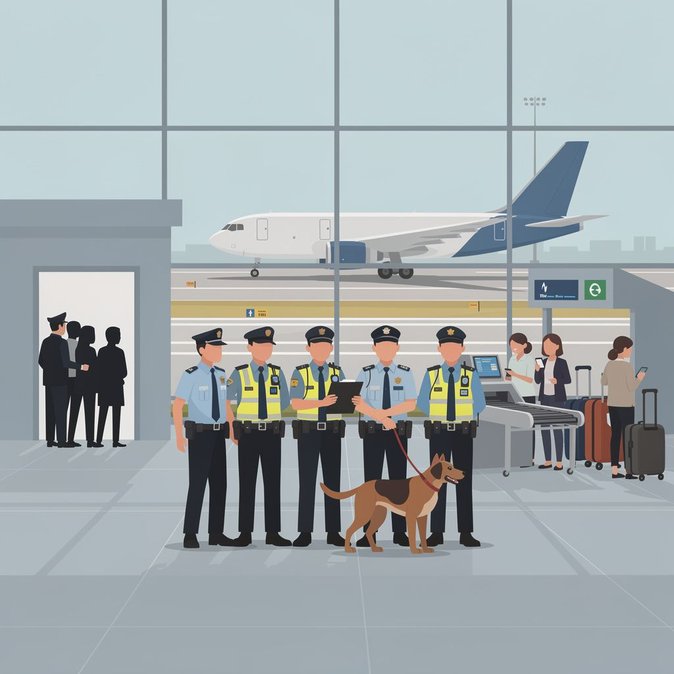
Brazil’s Polícia Federal (PF) reported on 7 July that its airport task-force had detained seven travellers and seized 3.5 kg of cocaine during intensified migration and customs checks conducted between 3 and 5 July at São Paulo/Guarulhos International Airport (GRU). The sting illustrates the dual role the PF plays as both border-control authority and criminal-investigation branch. In the most serious case, officers intercepted a Nigerian national en route to Addis Ababa who had swallowed 1.5 kg of cocaine in pellet form. The passenger was taken to a hospital under armed guard for medical extraction – a procedure that can take up to 48 hours. A Brazilian woman attempting to board a Barcelona flight with 2 kg of cocaine sewn into her clothing was also caught. Both face international drug-trafficking charges that carry penalties of 5–15 years under Brazil’s Drugs Law. Beyond narcotics offences, border agents arrested a Brazilian bound for London after X-ray scanners revealed live ammunition in his luggage. Four additional fugitives wanted for crimes ranging from unpaid child support to drunk driving were flagged by the PF’s API-PNR system during passport control and taken into custody when their boarding passes were scanned. Why it matters for global mobility: GRU is Latin America’s second-busiest international hub and the primary gateway for corporate travellers. The PF operation signals a tighter security posture ahead of the Southern Hemisphere’s winter-holiday peak and the 9 July state holiday, when passenger volumes surge. Travellers should expect longer queues at secondary screening and are advised to arrive at least three hours before departure, even for regional flights. Companies moving high-value staff or time-sensitive cargo through GRU may want to build extra buffer into itineraries and alert employees to Brazil’s strict stance on controlled substances – including prescription medicines without proper documentation – to avoid inadvertent detention.