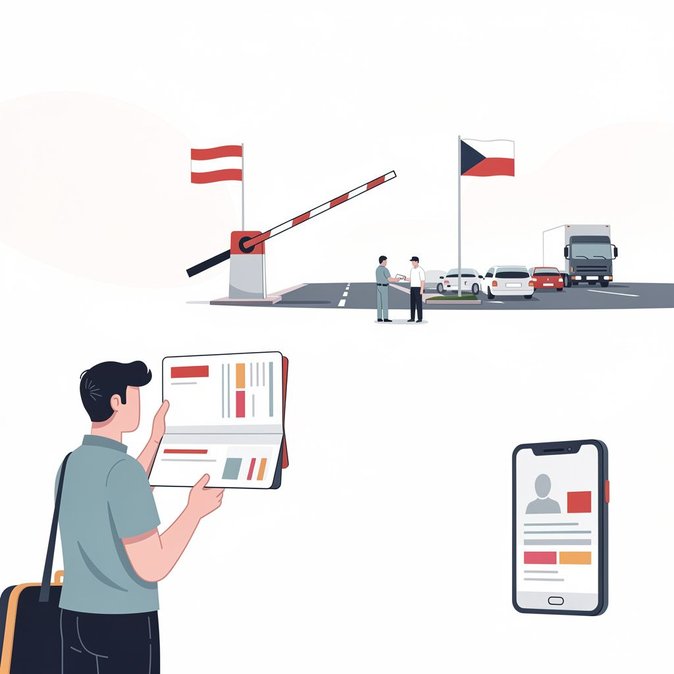
Austria’s Ministry for European and International Affairs (BMEIA) issued a routine refresh of its country page for the Czech Republic on 9 July 2026, keeping the risk level at the lowest “Sicherheitsstufe 1” but updating practical details for cross-border travel. The guidance is particularly relevant for commuters and logistics providers operating across the busy north-south corridor linking Vienna with Brno and Prague. Most headline rules are stable: Austrian and other EU citizens can still enter the Czech Republic with a valid passport or ID card and stay up to 30 days before registering their residence. However, the page explicitly reminds travellers that Austria is maintaining “punktuelle Grenzkontrollen” (targeted internal Schengen checks) along the Czech frontier until at least 15 September 2026. Drivers must therefore carry a valid Austrian passport or ID card even when using minor crossings such as Haugsdorf–Hate, where the road briefly traverses Czech territory before re-entering Austria. The ministry’s legal team also clarifies that Austria’s new electronic identity card—ID Austria—is accepted only domestically for now and not recognised by Czech border police. This distinction is critical for cross-border workers who have begun to rely on the digital document for everyday transactions inside Austria but still need a physical passport to avoid fines when commuting to South Moravia’s industrial zones. Companies running shuttle services between Vienna and Czech production sites should factor in potential delays at staffed checkpoints, especially during the summer construction season that routinely clogs the A5 and S3 corridors. Logistics managers may wish to build in buffer time and ensure that shipment drivers carry power-of-attorney letters and CMR documents, as spot controls often extend beyond simple ID verification. Although the security environment remains comparable to Austria’s, BMEIA repeats standard anti-pickpocket advice for Prague’s tourist hotspots and Prague Airport taxi ranks. Mobility managers should circulate the refreshed guidance to assignees and remind them that lost-and-found passports reported to Austrian police should not be reused, as Czech officers may still mark them invalid in their databases.