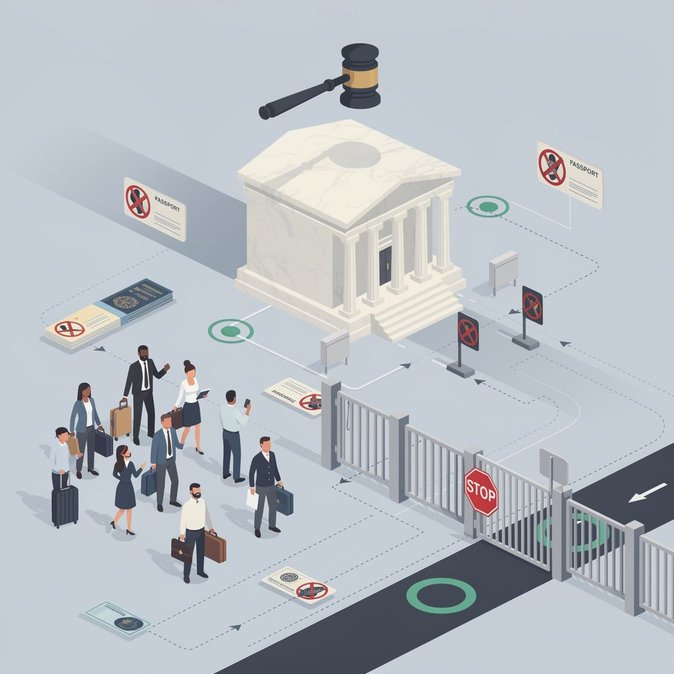
In a string of high-profile rulings issued on the final day of the 2025-26 term, the U.S. Supreme Court largely sided with the Trump administration on questions ranging from asylum processing to the rights of returning green-card holders and the future of Temporary Protected Status (TPS). With the exception of its widely publicized decision to preserve birth-right citizenship, the Court gave the executive branch broad latitude to interpret—and in some cases roll back—statutory immigration protections.
By blessing a DHS policy that allows border officers to treat certain lawful permanent residents as "arriving aliens," the Court has effectively introduced a new risk factor for employees who travel internationally while facing unresolved criminal charges. Companies will need to update travel-risk matrices and advise permanent residents that an indictment—let alone a conviction—can now trigger heightened screening and possible parole-in-place on re-entry.
The Court’s green light for the administration’s so-called “turn-back” policy at ports of entry also alters the calculus for humanitarian parole programs many employers use to relocate key talent who cannot secure visas in their home countries. Lawyers warn that the ruling may standardize tougher initial screening at land borders, increasing the time—and legal support—needed to move staff across the U.S.–Mexico border for short-term projects.
At a practical level, employers scrambling to navigate these shifting entry rules may find it useful to lean on third-party documentation specialists. VisaHQ, for instance, offers real-time updates on U.S. immigration requirements and can expedite everything from humanitarian parole requests to employment-based visa applications—services that help HR teams keep projects on track when legal standards change overnight. More details are available at
Perhaps most consequential for long-range workforce planning is the Court’s holding that decisions to terminate TPS designations are shielded from most judicial review. Hundreds of thousands of Haitian and Syrian nationals employed under TPS-linked Employment Authorization Documents (EADs) now face accelerated removal timelines unless Congress acts. Employers that rely on TPS workers should prepare for recruitment gaps, conduct I-9 audits, and explore alternative visa strategies such as H-2B or EB-3 sponsorships.
Taken together, the term’s rulings signal a Supreme Court increasingly deferential to executive immigration authority whenever the dispute turns on statutory—rather than constitutional—interpretation. Mobility stakeholders should expect fewer successful nationwide injunctions and more rapid policy swings after future elections, reinforcing the need for real-time compliance monitoring and agile talent-deployment strategies.
By blessing a DHS policy that allows border officers to treat certain lawful permanent residents as "arriving aliens," the Court has effectively introduced a new risk factor for employees who travel internationally while facing unresolved criminal charges. Companies will need to update travel-risk matrices and advise permanent residents that an indictment—let alone a conviction—can now trigger heightened screening and possible parole-in-place on re-entry.
The Court’s green light for the administration’s so-called “turn-back” policy at ports of entry also alters the calculus for humanitarian parole programs many employers use to relocate key talent who cannot secure visas in their home countries. Lawyers warn that the ruling may standardize tougher initial screening at land borders, increasing the time—and legal support—needed to move staff across the U.S.–Mexico border for short-term projects.
At a practical level, employers scrambling to navigate these shifting entry rules may find it useful to lean on third-party documentation specialists. VisaHQ, for instance, offers real-time updates on U.S. immigration requirements and can expedite everything from humanitarian parole requests to employment-based visa applications—services that help HR teams keep projects on track when legal standards change overnight. More details are available at
Perhaps most consequential for long-range workforce planning is the Court’s holding that decisions to terminate TPS designations are shielded from most judicial review. Hundreds of thousands of Haitian and Syrian nationals employed under TPS-linked Employment Authorization Documents (EADs) now face accelerated removal timelines unless Congress acts. Employers that rely on TPS workers should prepare for recruitment gaps, conduct I-9 audits, and explore alternative visa strategies such as H-2B or EB-3 sponsorships.
Taken together, the term’s rulings signal a Supreme Court increasingly deferential to executive immigration authority whenever the dispute turns on statutory—rather than constitutional—interpretation. Mobility stakeholders should expect fewer successful nationwide injunctions and more rapid policy swings after future elections, reinforcing the need for real-time compliance monitoring and agile talent-deployment strategies.