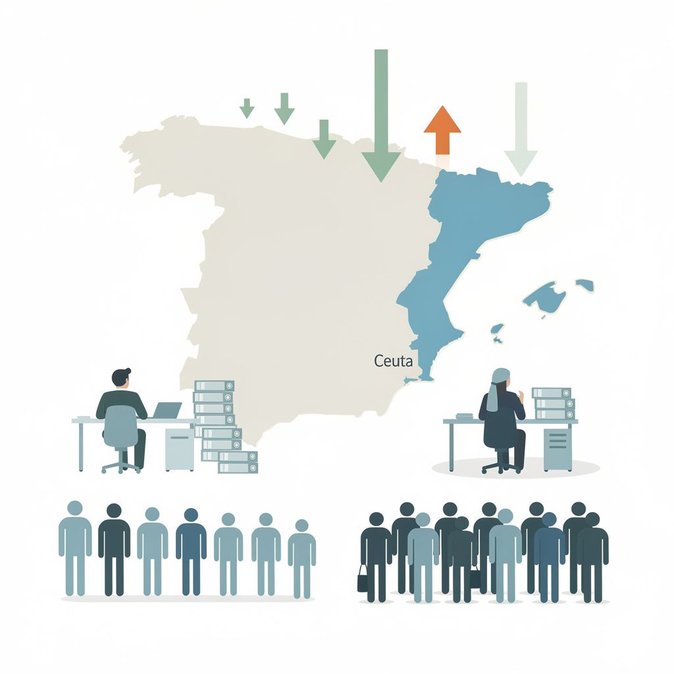
Fresh Interior Ministry statistics show that irregular arrivals to Spain’s Balearic Islands slipped to 3,244 persons as of 15 July—140 fewer than the same period a year ago. The archipelago saw 172 small boats, three fewer than in 2025, while nationwide sea arrivals dropped 36 % year-on-year to 11,488. The downward trend is even sharper at national level: total irregular entries—sea and land—stand at 14,479, a 24.7 % fall over 2025. The figures will be welcomed by employers that depend on seasonal permits, because lower boat pressure normally frees up administrative capacity at foreigners’ offices. Ceuta is the outlier: land entries there have skyrocketed 149 % to 2,826 people, reflecting shifting smuggling routes after Moroccan crack-downs in the Atlantic. For companies operating in the self-governing enclave, ID checks and onboarding schedules may face sporadic disruption as authorities reinforce controls. Policy-wise, Madrid credits stepped-up maritime patrols, joint intelligence cells with Rabat and the new EU Pact on Migration and Asylum—whose responsibility and solidarity rules started applying on 12 June—for the calmer picture. NGOs counter that calmer seas and the post-pandemic travel rebound simply encourage more regular pathways, particularly Spain’s six-month-old extraordinary regularisation programme that has already attracted over one million applications. Either way, global mobility teams should monitor border-city processing times. A stable marine picture in the Balearics could translate into quicker turnaround for legal-entry applicants who must finalise residence cards on the islands.
Source: Mallorcadiario