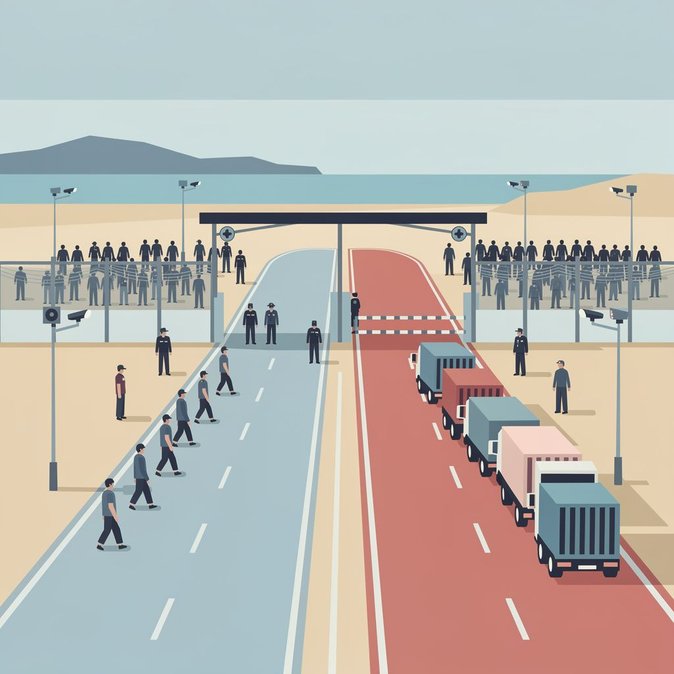
Spain’s foreign minister, José Manuel Albares, confirmed on Catalunya Ràdio this morning that his department has activated “preventive mechanisms” to deter calls circulating on Moroccan social media for a coordinated rush on the Ceuta border scheduled for 23 September. Digital outreach teams are counter-messaging in Arabic, French and Spanish, warning that irregular entry confers no automatic right to remain in the Schengen area and may lead to immediate return under bilateral readmission protocols. Behind the scenes, Spain has requested intelligence sharing and additional patrols from Morocco’s Gendarmerie Royale while redeploying Policía Nacional riot units to the Tarajal crossing. The measure follows last year’s June surge when 2,100 people attempted to breach the border fence in a single day, forcing the temporary closure of the commercial gate and disrupting freight flows between Andalusian factories and Moroccan suppliers. Any large-scale incident would again jeopardise the recently re-launched trusted-traveller programme for cross-border workers—a scheme on which more than 3,500 Spanish and Moroccan commuters depend daily. Business chambers in both Ceuta and neighbouring Cádiz province fear renewed unrest could delay long-planned upgrades to the border’s ‘smart-gate’ lanes, funded by €32 million of EU recovery money earmarked to speed cargo inspections. Mobility stakeholders with personnel transiting through Ceuta or Melilla in the coming days should advise travellers to carry original passports, arrive early and monitor official alerts from Spain’s Interior Ministry. Companies that shuttle technicians across the frontier for ship-repair, telecoms or retail projects should prepare contingency rotations or remote-work alternatives in case of temporary closures.
Source: Cadena SER