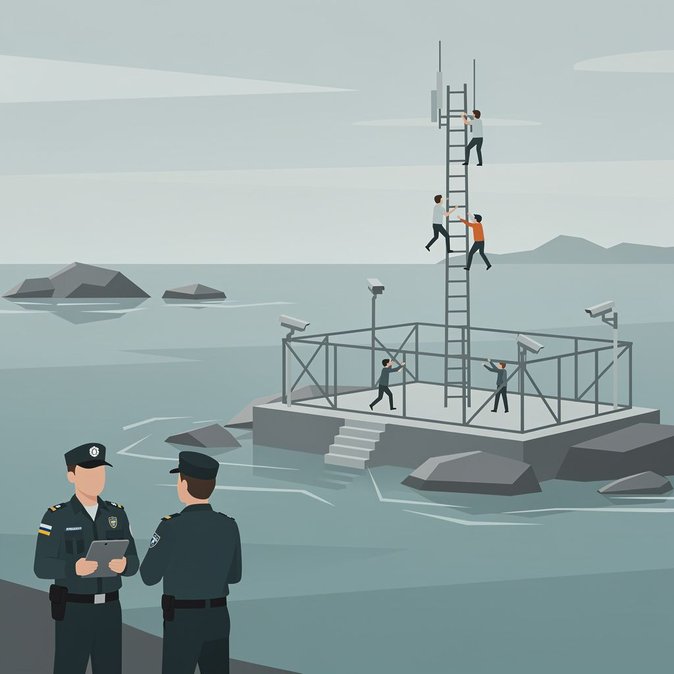
The Finnish Border Guard confirmed on 24 September 2026 that it has completed a preliminary investigation into a late-July security breach on Glosholmen Island, a strategically located, fenced-off site under Border Guard administration near Porvoo in the Gulf of Finland. Four individuals are now suspected of aggravated trespass and vandalism after allegedly climbing a radio-mast inside the closed zone on 31 July. Surveillance alarms triggered an immediate response, allowing a sea-patrol from the Gulf of Finland Coast Guard District to intercept six people, four of whom now face charges. Although no classified equipment was damaged, the incident has sharpened debate around critical-infrastructure protection at Finland’s maritime border, which has become an even higher priority since Finland joined NATO in 2023 and as tensions with Russia persist. The Border Guard emphasised that entry to its restricted areas is prohibited without written authorisation and that physical barriers—fencing and concertina wire—are clearly marked with multilingual warning signs. Investigators said the suspects admitted their actions during questioning; the case has been forwarded to the District Prosecutor for consideration. For international companies operating in Finland—particularly in energy, telecoms and logistics—the case is a reminder of the country’s strict liability environment regarding border zones and protected installations. Foreign employees or contractors unaware of access rules risk not only fines but also potential visa repercussions if convicted of intentional offences. Multinational firms are therefore advised to update induction materials for expatriate staff and to include explicit guidance on restricted-area compliance, especially for off-site team-building or recreational activities along the coast. From a mobility-management standpoint, the swift detection and interception illustrate Finland’s investment in sensor networks and integrated maritime surveillance, which contribute to Schengen-area border integrity. While the likelihood of targeted espionage has not been ruled out, authorities currently classify the event as an isolated breach rather than a coordinated hostile act. Nonetheless, companies should review crisis-response protocols, as employees involved—knowingly or not—in restricted-area violations could face detention pending investigation, disrupting assignments and travel schedules. Looking ahead, the Border Guard plans to reinforce public-awareness campaigns and will install additional perimeter lighting and CCTV analytics at key sites before winter. The investigation’s outcome may set a legal precedent for prosecuting trespass in high-security maritime areas, reinforcing Finland’s zero-tolerance stance on border-area infractions.