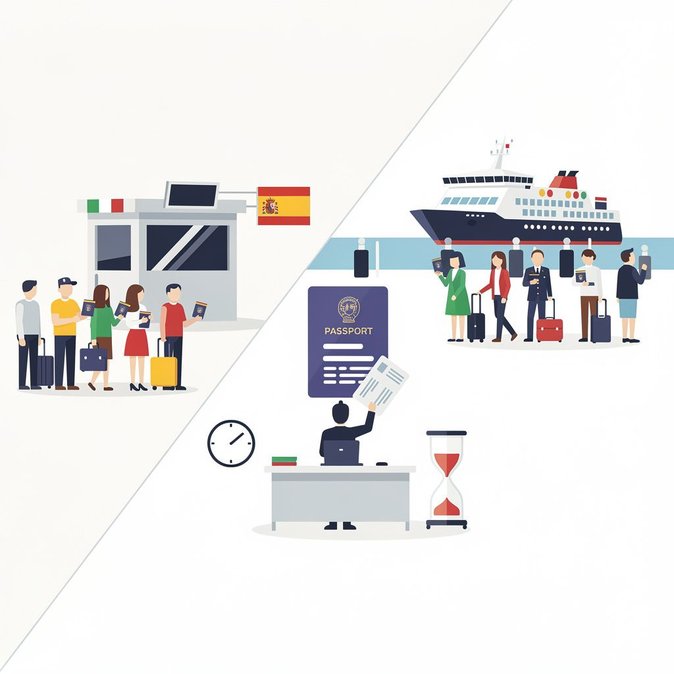
Business and leisure passengers flying or sailing from Italy to Spain will continue to face Schengen-internal passport inspections for at least another two weeks. The Spanish Interior Ministry’s Order INT/977/2026, published in the Boletín Oficial del Estado, prolongs the temporary re-introduction of border controls on air and passenger-sea links originating in Italy from 00:00 on 23 September through 24:00 on 7 October 2026. Spain first restored the checks on 8 August in a tit-for-tat response to Rome’s earlier suspension of free-movement rules for travellers coming from Spanish territory during a migrant surge in Ceuta. In practical terms, the measure does not block travel or introduce new visa requirements, but it does mean that all travellers—including EU citizens—must be prepared for a systematic document check on arrival. Airports in Barcelona, Madrid, Málaga and Palma de Mallorca, as well as ferry ports such as Barcelona and Valencia, will operate dedicated control points. Carriers have begun advising passengers to arrive earlier and to keep passports or national ID cards readily accessible to minimise queuing. Corporate mobility managers should factor additional buffer time into itineraries for staff who have onward connections inside Spain or tight meeting schedules. Travellers holding Italian residence permits or Schengen multi-entry visas remain entitled to enter Spain, but they must present originals, not digital copies. Employers moving equipment or product samples should also review hand-carry versus checked-baggage policies, as border police may ask for supporting documentation. Spanish authorities cite “serious threats to public order and internal security linked to irregular migration flows” as justification, but they emphasise that the extension is under continuous evaluation and could be lifted early if conditions allow. Unless a new order is issued, controls will automatically expire at midnight on 8 October. Businesses should therefore monitor official notices and airline alerts in early October, as a further extension would coincide with the autumn conference and trade-fair season, traditionally a peak period for Italy–Spain corporate travel. Looking ahead, the episode illustrates how quickly intra-Schengen travel can become subject to formal border checks. Mobility planners should maintain contingency budgets and communications protocols so that employees know what to expect and how to document any delay-related costs for reimbursement.