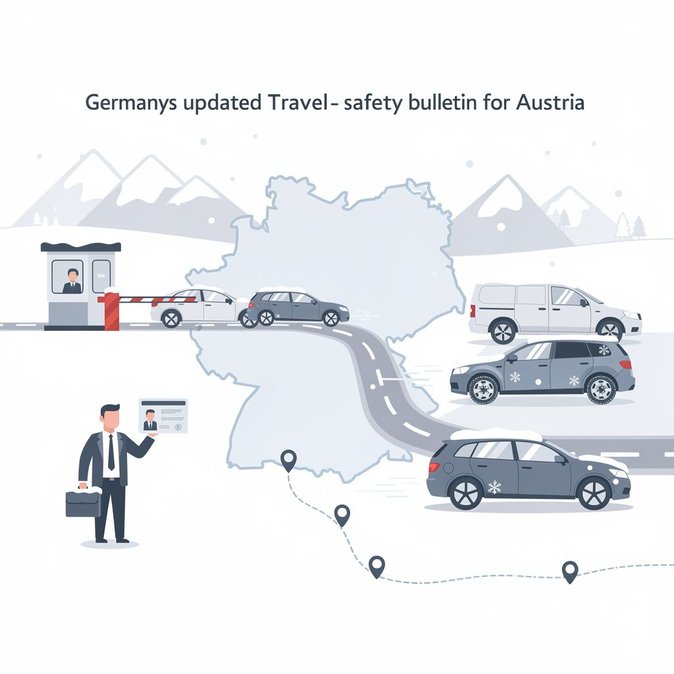
Germany’s Federal Foreign Office has issued a fresh update (27 September 2026) to its travel and safety advice for trips to Austria. While the overall security rating remains unchanged, the bulletin adds detailed guidance on Austria’s reinstated Schengen internal-border controls, winter-driving rules and new EU ID-card standards. The advisory reminds German and other EU travellers that Austria continues to perform “situational, flexible” checks at all land borders and airports, with systematic controls on crossings from Slovakia, Czechia, Hungary and Slovenia. Motorists are urged to consult ASFINAG’s live feeds for potential wait times and to carry a valid passport or EU ID card, as driver’s licences are not accepted documents for entry. A new section flags the 3 August 2026 EU regulation that invalidates non-machine-readable identity cards for cross-border travel. Travellers using older IDs risk being turned away at Austrian checkpoints. The Foreign Office also reiterates that from 1 November to 15 April, vehicles must be equipped with winter tyres or chains when conditions require, a rule often overlooked by business travellers on short assignments. For companies running cross-border projects, the advisory’s importance lies in compliance: HR departments should verify that posted workers and frequent travellers carry compliant IDs and understand the documentation checks that may occur en route. Logistics teams should build buffer time into schedules for lorry routes that transit Austria’s eastern frontiers. Although the update is mainly advisory, failure to heed ID or equipment requirements can incur on-the-spot fines of up to €300. The update underscores how national travel advisories are becoming a frontline tool for managing mobility risks within the Schengen Area as border-control exemptions proliferate.