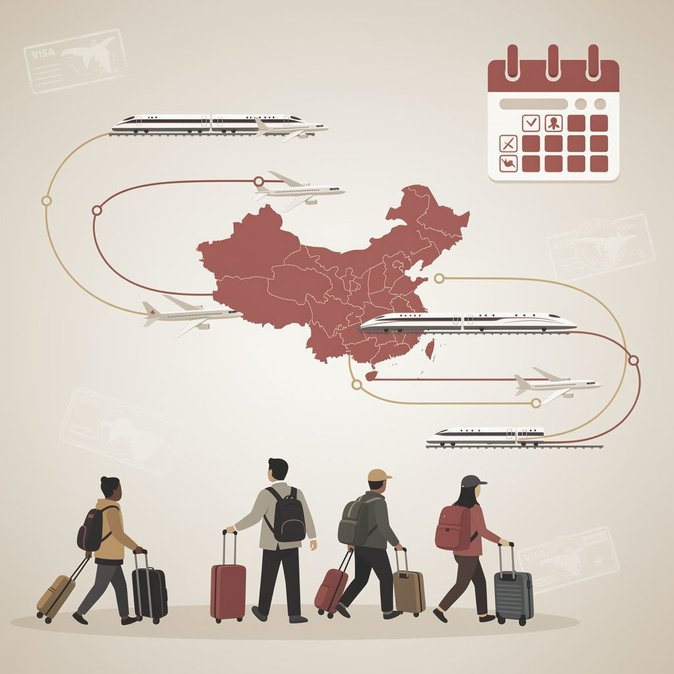
China’s National Immigration Administration (NIA) reported on 28 September that border checkpoints handled 6.709 million inbound and outbound movements during the three-day Mid-Autumn Festival (25–27 September). That represents a 16.8 per cent increase over the same holiday last year and marks the busiest mid-autumn travel period since pre-pandemic 2019. Of the total, mainland residents accounted for 3.206 million trips (up 5.3 %), Hong Kong/Macao/Taiwan residents 2.775 million (up 27.7 %) and foreign nationals 728,000 (up 37.7 %). Notably, 247,000 foreign visitors—about one-third of the total—entered China visa-free under Beijing’s expanded unilateral waiver programme for 45 countries, a 32.7 per cent year-on-year rise. The NIA attributed the smoother flows to predictive passenger modelling and the full deployment of e-gates at key airports such as Beijing Capital, Shanghai Pudong and Guangzhou Baiyun. Checkpoints processed a record 309,000 conveyances (planes, ships, trains and vehicles), an 8.6 per cent annual increase. For businesses, the figures confirm that China’s partial visa liberalisation—coupled with recently introduced online arrival cards—has materially lowered friction for short-term visits. Travel-risk consultants, however, warn that daily peaks of 234,000 on 26 September caused wait times above 40 minutes at Shenzhen Bay and Gongbei, suggesting advance scheduling for year-end expatriate rotations. The data also guides future resource planning: airlines serving Tier-2 cities benefited from visa-free travellers exerting pent-up demand, with seat factors on Beijing–Chengdu and Shanghai–Xi’an routes exceeding 92 per cent during the break. Mobility managers should expect higher fares around the upcoming National Day holiday, when NIA will redeploy extra officers but expects volumes to double those of Mid-Autumn.
Source: Xinhua News Agency