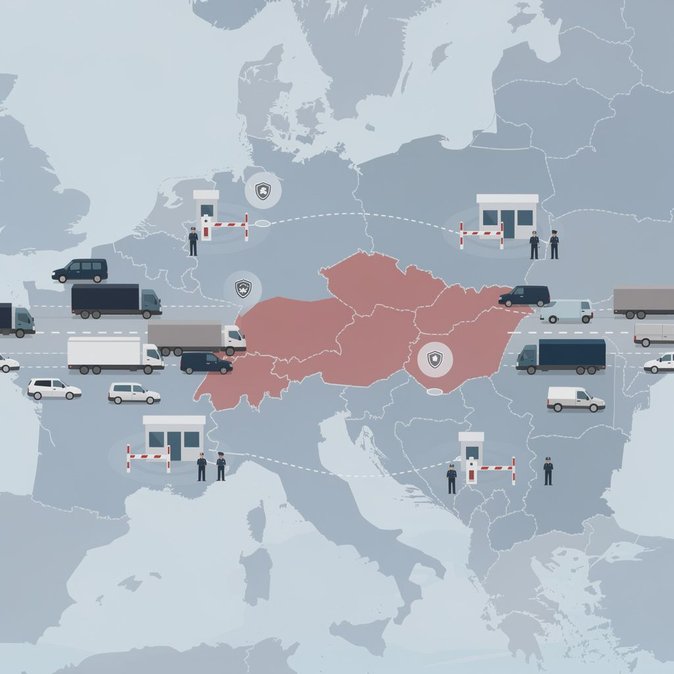
The European Commission today published the latest overview of Schengen countries that are currently making use of the ‘emergency clause’ in the Schengen Borders Code. Austria formally notified Brussels that it will prolong the temporary re-introduction of controls at its land and river borders with Slovakia as well as its land borders with the Czech Republic, Hungary and Slovenia for another six-month period, running from 16 September 2026 to 15 March 2027. Vienna justifies the step with “continuous threats to internal security posed by irregular migration, pressure on the asylum-reception system, Russia’s war of aggression against Ukraine, and the wider security situation in the Middle East.” In practical terms, travellers can expect spot checks on the A4 (Hungary), A5 (Czechia), A9 (Slovenia) and B9 (Slovakia) corridors, as well as closer scrutiny on regional roads and rail crossings. Commercial freight flows are also affected: haulage firms report queue times of up to two hours on heavy-traffic days, and customs brokers warn companies to factor potential delays into just-in-time supply chains. For cross-border commuters and business travellers the controls mean that a passport or national ID card remains mandatory, even though Austria and its neighbours are all members of the passport-free Schengen zone. The Interior Ministry has reminded employers to issue confirmation letters for posted workers who cross the border daily. Airlines operating ‘tag-on’ domestic segments (e.g., Vienna–Linz after an international leg) are unaffected, as the scheme only covers land and river borders. From a corporate-mobility perspective, the most immediate impact is on assignment planning and relocation budgets. Immigration advisers recommend allowing extra transfer time when sending employees to customer sites in Brno, Bratislava, Győr or Maribor and budgeting for overnight accommodation when late-evening return trips may be compromised by congestion. Logistics managers are likewise advised to build buffer stock or use alternative rail routes where possible. Politically, Austria’s decision fits a wider pattern: Germany, Denmark, Italy and several other states have also prolonged internal checks amid record asylum numbers. Brussels is expected to publish an opinion on proportionality later this autumn, but in practice the Commission rarely overrules Member States on security grounds. Unless the overall migration picture eases, companies should prepare for a protracted period of ‘temporary’ controls that now look increasingly permanent.
How VisaHQ can help
VisaHQ simplifies the visa application process for individuals and businesses. Check current travel requirements, prepare the required documents and manage your application online through the VisaHQ Austria portal.More From Austria
View all
Austria Consolidates Schengen Implementing Act, Clarifies On-the-Spot Asylum Requests at Borders
Austria joins five-country ‘Core Group’ planning to relocate rejected asylum seekers to third countries