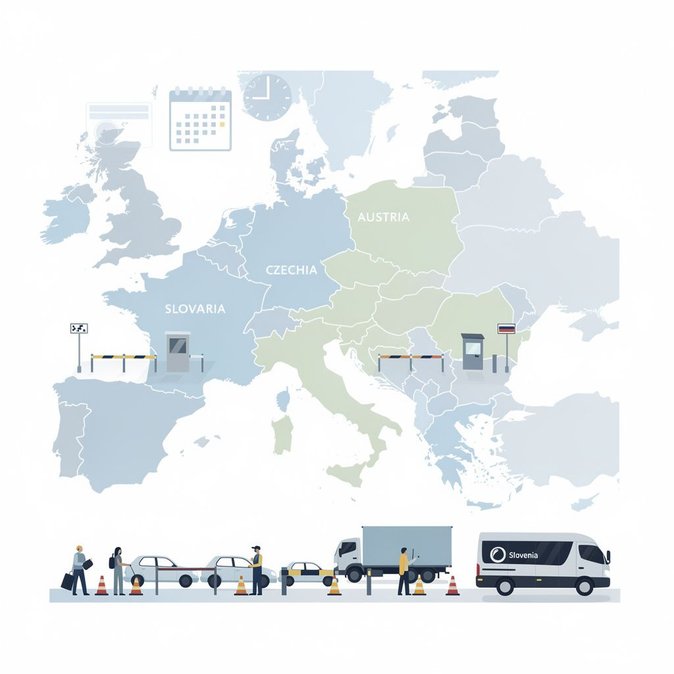
The European Commission’s live Schengen dashboard, updated on 5 October 2026, confirms that Austria will maintain controls at its land and river borders with Slovakia, Czechia, Hungary and Slovenia for the six-month period running 16 September 2026 to 15 March 2027. Vienna cites “continuous threats to internal security posed by irregular migration” as well as spill-over risks from Russia’s war against Ukraine and unrest in the Middle East. Austria first reinstated these checks in 2015 during the refugee crisis and has renewed them every six months since. Under the reformed Schengen Borders Code, any extension beyond two years requires a detailed proportionality assessment; Austria is now in its third consecutive year, making Brussels’ scrutiny sharper than ever. The Commission has already issued two opinions criticising Vienna for failing to show that alternative measures—such as joint police patrols—would be insufficient. For cross-border commuters and corporate shuttle services, the practical effect is continued queueing at secondary roads and rolling motorway checks, particularly on the A5 (Czech border) and A2 (Slovenian border). Although average waiting times remain under 20 minutes, peak-hour delays can stretch to an hour, disrupting just-in-time supply chains serving the Vienna and Graz regions. Mobility managers should anticipate renewed ID checks for assignees living in Bratislava but working in Vienna, and ensure they carry residence cards as well as passports. Trucking companies must budget extra driving time that could trigger tachograph infringements if not planned. Airlines using Ljubljana or Budapest as back-up airports for diversions into Austria should also remember that crew shuttles will cross an internal Schengen frontier that is no longer frictionless. Politically, the renewal feeds domestic debate ahead of Austria’s 2027 general election, where border security is a flagship issue for right-wing parties. Unless migration pressures ease, further prolongations are likely, but each will face tighter legal hurdles. Businesses should therefore track Commission opinions closely: a sudden order to lift controls could happen with only a few weeks’ notice, re-shaping risk assessments for posted-worker compliance and supplier logistics.