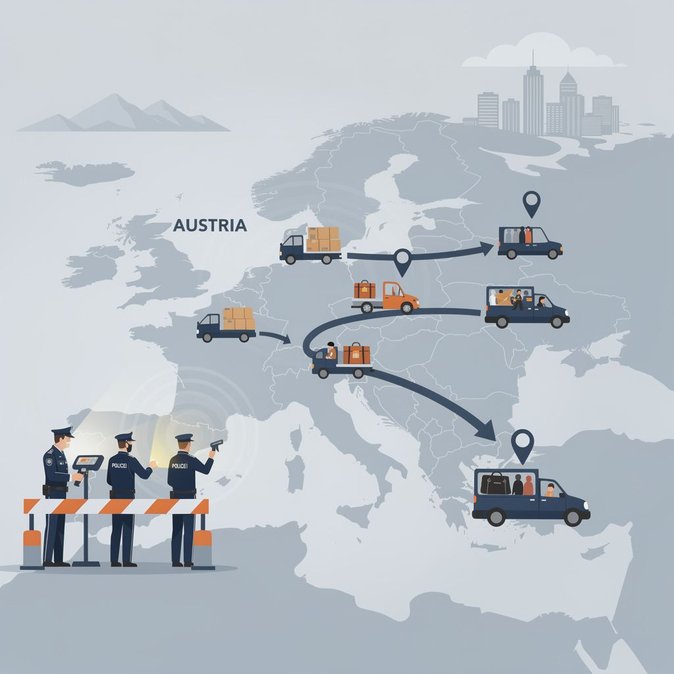
An international law-enforcement sweep code-named “Balkan Bridge II” has broken up a criminal network trafficking migrants, drugs, weapons and counterfeit goods across south-eastern Europe. Bulgarian Border Police announced on 4 October that the week-long operation involved officers from Austria, Germany, Italy, France, the United States and the United Kingdom, with observers from Japan, Greece and Romania. Raids took place at every Bulgarian border checkpoint, culminating in seizures of inflatable boats, narcotics and forged documents. Austrian liaison officers stationed in Sofia coordinated intelligence on routes that move irregular migrants from Türkiye through Bulgaria, Serbia and Hungary toward Austria and Germany. While exact arrest numbers have not been released, officials said dozens of suspected smugglers are now in custody and hundreds of would-be migrants intercepted. The ring allegedly charged up to €5,000 per person for transport and false papers, using small rivers and secondary roads to evade detection. For Austrian companies operating in the Western Balkans corridor, the takedown may ease short-term security concerns along key trucking lanes such as the E80 and E75. However, experts warn that pressure could shift to alternative routes through Romania or Croatia, prompting possible copy-cat smuggling attempts and additional ad-hoc border checks—especially on Austria’s eastern frontiers. Vienna’s participation underscores its broader strategy of externalising border management by embedding police and asylum officers in partner countries. Similar joint actions in 2025 led to a 30 percent drop in detected clandestine entries at Austria’s eastern borders, according to Interior Ministry statistics. Businesses should therefore expect Austria to push for more Frontex-backed operations and bilateral police deployments in 2027 budget talks. From a compliance standpoint, transport and logistics providers must remain vigilant: vehicle inspections are likely to intensify in coming weeks, and carriers found transporting undocumented migrants—even unknowingly—face fines of up to €5,000 per migrant under Austrian law. Companies should review driver training, install cargo-area seals, and maintain clear audit trails to demonstrate due diligence during any roadside inspection.
Source: Bulgarian News Agency (BTA)