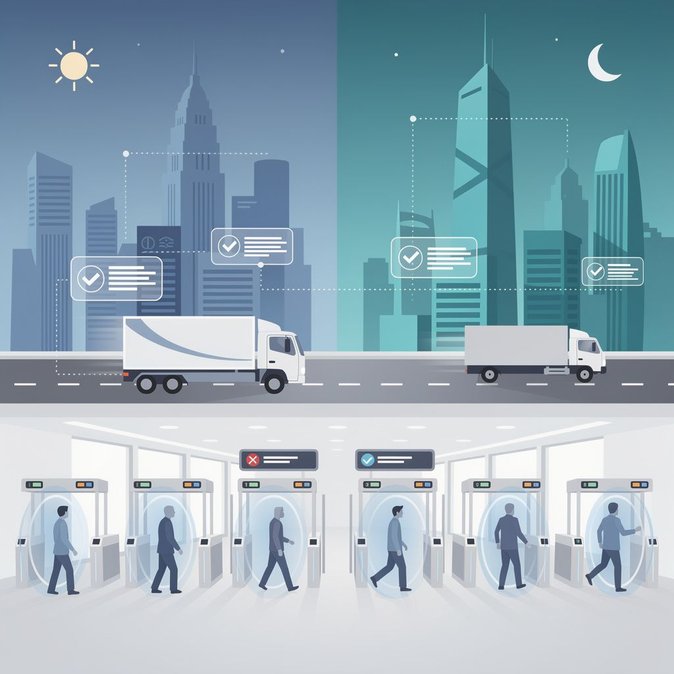
China and Hong Kong reached another mobility milestone this morning when the completely rebuilt Huanggang Port—in the heart of the Shenzhen-Hong Kong boundary—re-opened to travellers and vehicles at 06:30 on 12 October 2026. The new facility replaces the temporary passenger buildings that have handled cross-border flows since the old port was demolished three years ago and immediately resumes round-the-clock operations, the only land checkpoint in the Greater Bay Area (GBA) to do so. Key to the upgrade is a fully automated “co-operative inspection, one-stop release” model. Travellers now pass through a single set of 134 self-service e-gates where officers from Hong Kong’s Immigration Department, Hong Kong Customs & Excise and the mainland’s Exit-Entry Border Inspection and Customs jointly verify documents and biometrics. The first passengers this morning cleared all formalities in roughly 20 seconds, according to on-site media reports. The system also integrates vehicle clearance: 68 traditional counters can be switched between cargo and private-car lanes as demand fluctuates, while joint one-stop lanes collect driver, cargo-manifest and radiographic data in one drive-through inspection. For businesses the implications are immediate. Logistics firms can once again route late-night or early-morning cross-border trucks through Huanggang instead of detouring to the Hong Kong–Zhuhai–Macao Bridge, saving up to 45 minutes per run at off-peak hours. Commuters working on opposite sides of the boundary regain a true 24-hour option, easing labour deployment for hotels, data centres and emergency-maintenance providers that rely on shift staff. The port is also a showpiece for China’s push to digitise border controls. All traveller e-gate data are streamed in real time to a joint command platform that analyses wait times, verifies duplicate entries and screens risk profiles against customs, immigration and public-health watchlists. Officials say the architecture will be replicated at the new Shenzhen Bay 2.0 checkpoint and the Liantang/Heung Yuen Wai cargo channel in 2027. Finally, the opening dovetails with regional economic planning. The Futian commercial district on the Shenzhen side has already rezoned 38,000 m² of former border buffer land for “port economy” functions—bonded warehousing, cross-border e-commerce fulfilment and fintech sandboxes—signalling a shift from a pure transit node to an integrated logistics and innovation hub. For multinationals that base GBA supply-chain or R&D teams in both cities, faster clearance and bonded-zone support reduce the administrative and tax friction of moving people, prototypes and sensitive data across the boundary.