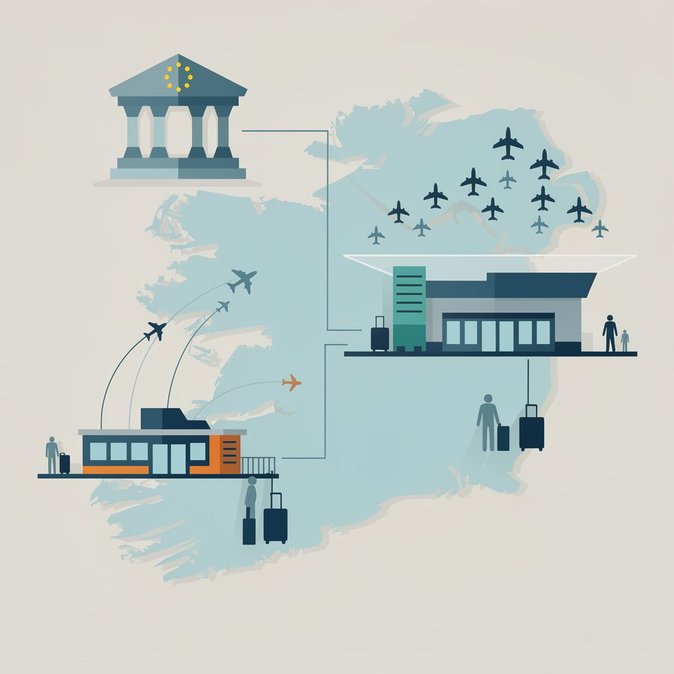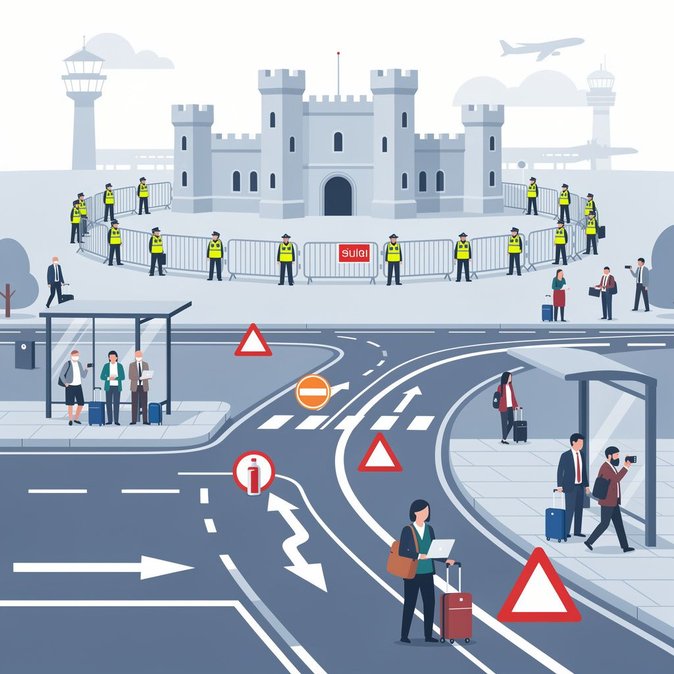
Dublin city centre is operating under an enhanced security plan today as education ministers from the 27 EU member states gather at Dublin Castle for a two-day informal Council meeting (15–16 October 2026). An Garda Síochána has erected an inner cordon around the Castle precinct and Dame Street, while intermittent road closures are in place on the North Quays and the South Circular Road to facilitate police convoys. Garda liaison officers have been deployed to Dublin Airport and Heuston and Connolly rail stations to help delegates and to keep commuter flows moving. Transport Infrastructure Ireland (TII) and Dublin Bus have rerouted several city-centre services, and Luas Green Line trams are not stopping at St Stephen’s Green during ministerial arrival and departure windows. The National Transport Authority is encouraging commuters to work remotely where possible and warns that journey times to and from the airport may be 30–40 minutes longer during evening rush hour. For inbound business travellers, the main impact is likely to be extended transfer times between the airport and hotels in the south city, as well as tighter security screening at conference venues. Hotels around Temple Bar report occupancy levels of 95 per cent, with average daily rates up 18 per cent on the same dates last year, reflecting high demand for rooms with controlled-access perimeters. While Dublin Airport itself is operating a normal flight schedule, daa, the airport operator, advises passengers to allow at least two hours for short-haul departures and three for long-haul during the summit window. Companies moving talent or equipment into Ireland this week should factor potential delay costs into itineraries and consider using Cork or Shannon as alternative entry points for time-sensitive shipments. The Garda has stressed that the measures are temporary and will be lifted once the final ministerial convoy departs late on Friday evening. Nevertheless, the event offers a reminder that Ireland’s capital, though compact, can experience disproportionately large mobility disruptions whenever high-level political events overlap with peak commuter periods.
Source: An Garda Síochána