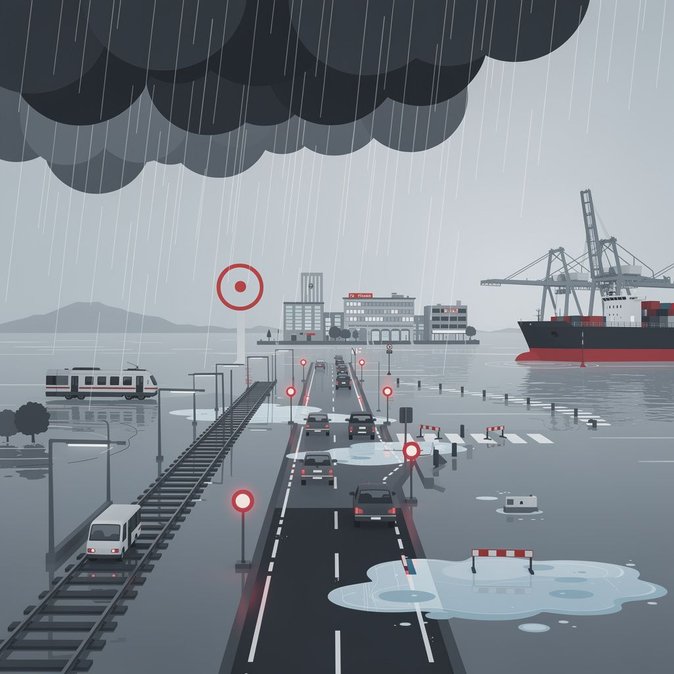
An intense Atlantic disturbance swept across north-western Tuscany and eastern Liguria overnight, forcing the regional civil-protection authority to issue a rare codice rosso (red alert) for hydro-geological risk that remains in effect until 24:00 on Thursday, 12 November. The warning covers Lunigiana, Garfagnana and stretches of the Reno valley, all key transit corridors for freight moving between the Tyrrhenian ports (La Spezia, Livorno) and the Po Valley. According to the regional operations room, rain totals already exceed 120 mm in parts of the Apennines, with peaks of 226 mm recorded at Castelnuovo Magra in Liguria. Several minor rivers broke their banks: the Bardine flooded the municipal road to Posterla and Marciaso near Fivizzano, while the Serchio briefly overtopped the SS12 near Lucca, closing the arterial route that links Florence with the coast. Trenitalia suspended regional rail services on the Lucca–Aulla and Pisa–La Spezia lines for safety checks, and road hauliers are being rerouted via the Cisa (A15) motorway, where speed limits have been reduced to 60 km/h because of standing water and wind gusts above 70 km/h. Ports are also affected: the Harbour Master in La Spezia ordered container vessels to delay manoeuvres after wave heights reached 3–4 m, while ferry operator Toremar cancelled two morning sailings to Elba. Florence Airport is operating normally, but the Farnesina’s Unità di Crisi is advising travellers to allow extra time for ground transfers and to monitor airline notifications in case runway capacity is reduced later in the day. Business travellers heading to industrial sites in the Versilia marble district or Lunigiana’s paper mills should expect road closures and possible power outages. Employers with posted workers in the affected areas are reminded of their duty-of-care obligations and should verify that local accommodation meets emergency-preparedness standards. The red alert automatically activates Italy’s simplified extraordinary-leave scheme, allowing employees who are unable to reach the workplace because of civil-protection orders to justify absences without loss of pay. Forecasters at the LaMMA consortium expect the frontal system to weaken overnight, downgrading the alert to orange on Friday, but secondary landslides remain possible as soils are saturated. Companies arranging Monday-morning crew changes at La Spezia’s shipyards or worker transfers to Carrara should reconfirm transport 24 hours in advance.
Source: ANSA