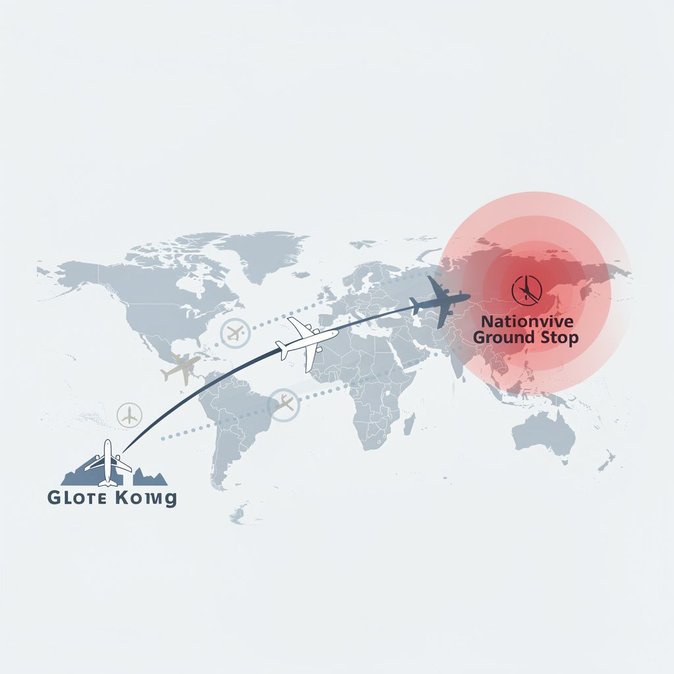
A four-hour nationwide ground stop ordered by the U.S. Federal Aviation Administration (FAA) on 13 November (U.S. time) has spilled over into the Pacific, forcing airlines to cancel or delay at least 17 flights linking Hong Kong and five U.S. gateways. By noon on Saturday 14 November, the Airport Authority Hong Kong confirmed two outright cancellations and 14 delays affecting services operated by Cathay Pacific, United Airlines and American Airlines. The stoppage was triggered by an outage in the FAA’s communications network that froze departures across the continental United States. Although the order was lifted after four hours, recovery has been slow because aircraft and crew were left out of position. Inbound flights to Hong Kong originating from Los Angeles, San Francisco and New York saw delays of up to nine hours, with knock-on effects on Sunday’s schedules. Cathay Pacific provided hotel accommodation for stranded passengers in the United States and warned that "rolling delays" could continue through 15 November. The carrier advised customers to update contact details and check flight status notifications before travelling to the airport. Freight forwarders also reported that some high-value cargo had to be rerouted via Seoul and Taipei because of missed transfer windows. For corporate mobility teams, the incident highlights the fragility of long-haul travel corridors that depend on U.S. air-traffic infrastructure. Companies with time-critical travel between Hong Kong and North America should maintain alternative routings—such as one-stop itineraries via Vancouver or Tokyo—and ensure traveller tracking systems capture real-time schedule changes. Marine-crew change agencies and tech firms moving engineers to U.S. data-centre projects were among those most affected. While trans-Pacific operations are expected to normalise by 16 November, analysts note that similar system failures in January 2023 and August 2025 each took more than 36 hours to work through the global network. Business-aviation operators should therefore anticipate airport slot congestion and potential crew-duty-time extensions when U.S. ground stops occur.
Source: Newsdesk.hk