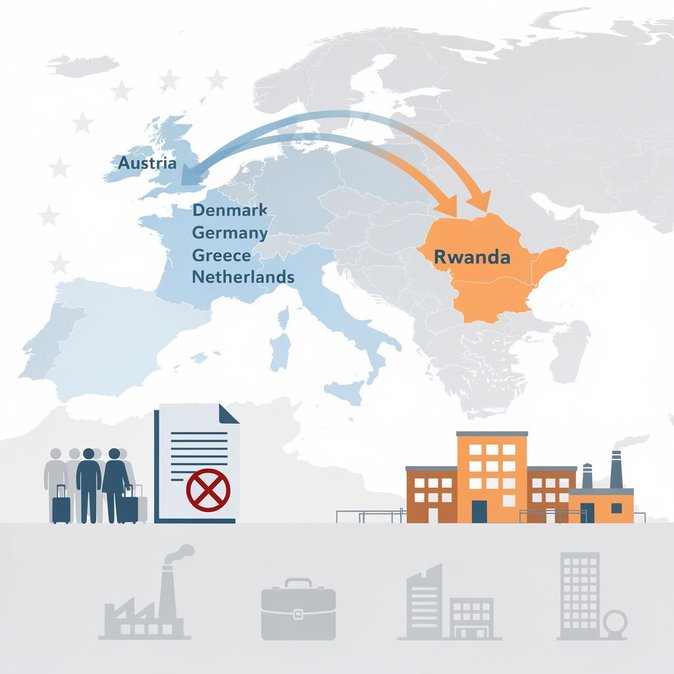
At a joint press conference in Vienna on 16 November 2026, Austrian Chancellor Christian Stocker stood alongside ministers from Denmark, Germany, Greece, the Netherlands and Rwanda to announce that the six countries have agreed “in principle” to establish a European “Return Hub” in Kigali. Under the draft memorandum, migrants whose asylum applications were finally rejected anywhere in the participating states could be transferred to Rwanda as early as mid-2027. Austria has earmarked €15 million in its 2027 budget for preparatory work. The scheme is modelled on – but politically distinct from – the UK’s ill-fated Rwanda plan. Instead of outsourcing asylum processing, the EU partners want to move only those whose cases have been exhausted and who cannot be returned to their country of origin. Officials argue that concentrating return operations in one secure third country will break smugglers’ business model and reduce irregular entries. Danish Prime Minister Mette Frederiksen called the announcement “a milestone that will deter dangerous journeys across the Mediterranean.” Operational details remain vague. Austrian Interior Minister Gerhard Karner said the group is still negotiating flight logistics, case-selection criteria and an independent monitoring mechanism. Rwanda’s Interior Minister Vincent Biruta confirmed that Kigali would provide accommodation and vocational training, but stressed that all transfers must respect international human-rights standards. Legal experts warn that the plan will face intense scrutiny in the EU Court of Justice and the European Court of Human Rights. Amnesty International Austria called the accord “irresponsible,” arguing that past attempts to outsource migration control have led to arbitrary detention and refoulement. The ministers insist the hub will comply with the new EU Return Directive adopted in October 2026, which requires judicial review, access to lawyers and external monitoring. For multinational employers, the announcement signals that Austria and several key EU markets intend to harden removal rules for irregular migrants while keeping skilled-worker channels (such as Austria’s Red-White-Red Card) untouched. Companies should expect tighter ID checks at internal borders as public pressure mounts to show results before the first removals take place in 2027.
Source: Associated Press