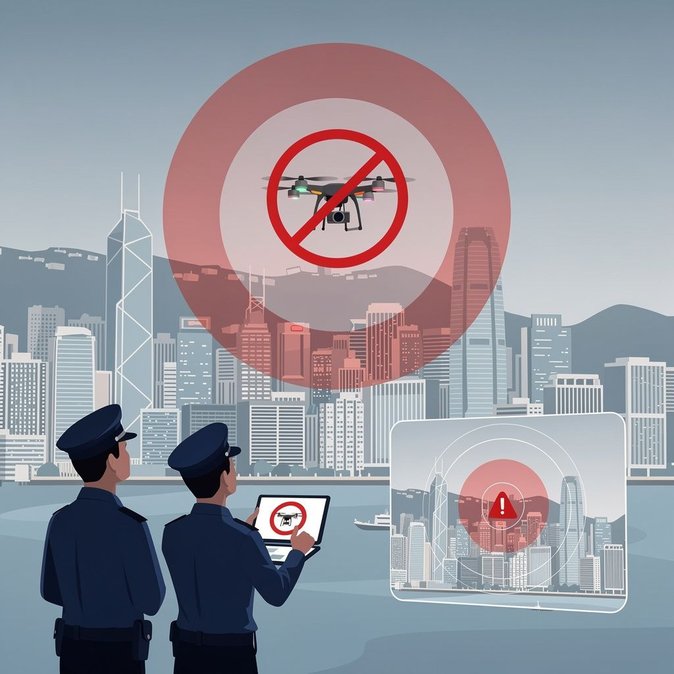
Hong Kong police have made the first arrests under the temporary air-space restrictions imposed for this week’s Asia-Pacific Economic Cooperation (APEC) Leaders’ Meeting in neighbouring Shenzhen. A 40-year-old man was detained in Nam Sang Wai during the early hours of 18 November after officers spotted a quad-copter hovering over wetlands inside the declared no-fly zone. Hours later, at about 10 p.m., a 67-year-old was arrested in Tin Shui Wai after allegedly launching a small drone from a riverside park. Both men are being held on suspicion of operating an unmanned aircraft without authorisation and breaching flight-safety regulations that carry a maximum penalty of HK$100,000 (US$12,800) and up to two years’ imprisonment. Under a joint order from the Civil Aviation Department and Police, all civilian drones, paragliders, airships, kites and even mass balloon releases are prohibited across the northern New Territories from 00:01 on 17 November until 23:59 on 20 November. At the same time, helicopters and light aircraft—other than those operated by the Government Flying Service—are grounded city-wide. The measures are designed to create a sterile buffer around Shenzhen’s APEC venue, 18 kilometres north of the border, and to simplify enforcement by ensuring that any non-state flight is automatically illegal. For mobility managers the restrictions have immediate operational consequences. Media production crews have had to cancel aerial filming, engineering firms have postponed drone surveys and cross-boundary helicopter charters that normally link Hong Kong’s Central Heliport with Shenzhen’s Bao’an International Airport have been suspended. Business travellers planning to arrive by private helicopter from Macau or Zhuhai must reroute via Hong Kong International Airport (HKIA) and continue by land or ferry. The Civil Aviation Department has advised companies to factor longer transfer times into itineraries and to check NOTAMs for last-minute changes. The arrests highlight the strict liability nature of Hong Kong’s Small Unmanned Aircraft Order, which came into force in 2024. Operators must hold a permit for any commercial flight, register their aircraft, carry third-party insurance and keep records of each sortie. With public attention focused on the high-profile APEC summit—expected to draw U.S. President Donald Trump, Chinese President Xi Jinping and Russia’s Vladimir Putin—compliance will be closely watched. Human-resource and travel teams should remind assignees, especially engineers and surveyors accustomed to routine drone usage, that exemptions will not be granted until the ban lifts at midnight on Friday. Beyond APEC, the episode is a timely rehearsal for Hong Kong’s own large-scale events in 2027, including the National Games and the launch of the Northern Metropolis development, both of which will require similar temporary flight restrictions. Companies that rely on aerial data collection would be wise to incorporate contingency plans—such as satellite or ground-based LiDAR alternatives—into their mobility playbooks now.
Source: Newsdesk.hk