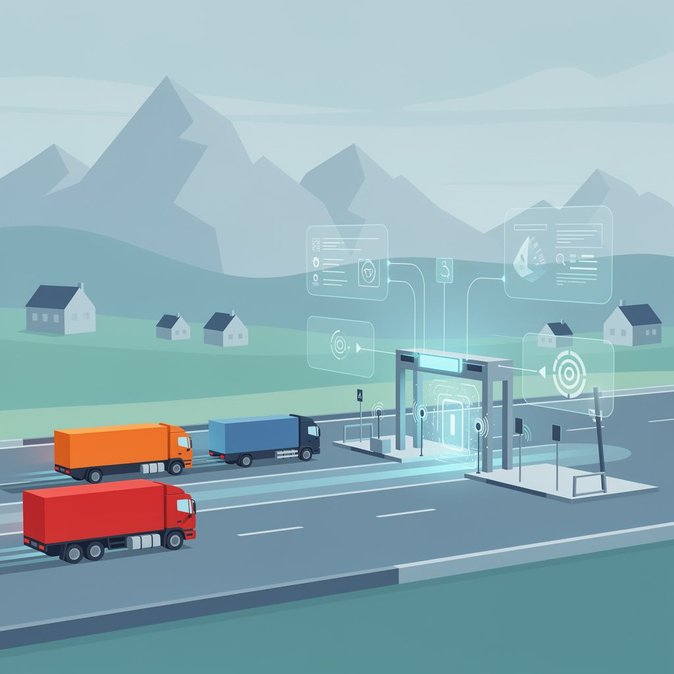
Austrian Finance Minister Markus Marterbauer and Vorarlberg Governor Markus Wallner on Thursday, 19 November 2026, formally switched on “Smart Border Austria”, a fully digitalised customs platform now operating 24/7 at all six commercial border crossings with Switzerland and Liechtenstein. The €19.1 million joint project by the federal Finance Ministry and the Land Vorarlberg replaces the paper-based “Laufzettel” system—dating back to 2003—with electronic pre-lodgement of cargo data linked to a vehicle’s licence plate. Cameras read the plate, the system checks the data set against the customs database and gives the driver a green light or directs the lorry to secondary inspection. Average clearance time has fallen from about two hours to just 21 seconds, allowing up to three trucks per direction to be processed every minute. The move is expected to eliminate chronic traffic jams on the A14 Rheintal Autobahn and at the Wolfurt inland terminal, a key hub for Alpine exports to Switzerland and northern Italy. Logistics giant Gebrüder Weiss, which took part in the pilot at Feldkirch-Tisis, reports that the digital corridor has already saved an estimated 4,000 driver-hours per month and cut idling emissions along the border towns of Höchst, Mäder and Hohenems. Customs authorities stress that 99 percent of crossings will now be “driver-free”, with intervention only when anomalies are flagged. Incorrect data are bounced back to the exporter’s IT system in real time, reducing costly re-routing. Austria is the first EU external border to introduce a fully automated clearance process; officials from Germany and Slovenia are scheduled to visit the installations next month. For international traders and mobility managers the benefits are tangible: predictable transit times on the busy Swiss-Austria axis, fewer demurrage charges and simplified document management that can be integrated into corporate ERP systems. The Finance Ministry expects the system to pay for itself within four years through lower staffing costs and higher trade throughput. Transport companies are now lobbying for the model to be replicated at the Hungarian and Slovenian borders, traditional bottlenecks on the west-east freight corridor.