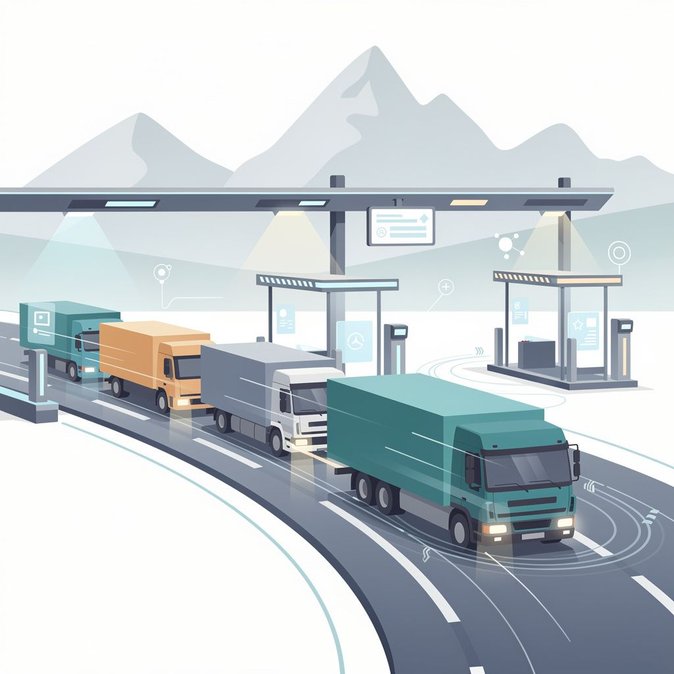
Austria’s Finance Ministry has put its ‘Smart Border Austria’ system into full 24/7 operation, cutting average customs-clearance times for commercial vehicles from two hours to just 21 seconds. The digital platform—jointly financed by the federal government (€18.4 million) and the province of Vorarlberg (€0.7 million)—covers six border posts that handle about 2,000 trucks per day on routes to Switzerland and Liechtenstein. Instead of queuing for manual stamps, hauliers now submit an electronic pre-notification containing vehicle registration and customs data. Automated licence-plate cameras compare the information with the database and direct drivers either to continue or to a control lane. The Finance Ministry says more than 99 percent of crossings are now fully automated, drastically reducing congestion around the Wolfurt freight terminal, a chronic bottleneck for alpine trade corridors. The project entered pilot mode in summer 2026 and moved into regular service on 1 October; full-scale, round-the-clock processing began on 1 November. Logistics giant Gebrüder Weiss, which helped design the workflow, calls the system a “game-changer” that illustrates how government and industry can combine forces to simplify border formalities while enhancing enforcement. For exporters and supply-chain managers the benefits are immediate: shorter transit times, lower fuel costs and improved schedule reliability on the high-value Switzerland–Germany–Austria triangle. The model could also inform the EU’s forthcoming electronic freight transport information (eFTI) regulation, which will require member states to accept digital documents for customs and transport by late 2027. Next steps include integrating ADR (hazardous-goods) data and extending the scheme to other Austrian road and rail crossings. The Finance Ministry is negotiating a data-sharing protocol with Swiss authorities to enable one-stop risk analysis, a move that would further speed up green-lane processing for trusted carriers.
Source: Austrian Ministry of Finance