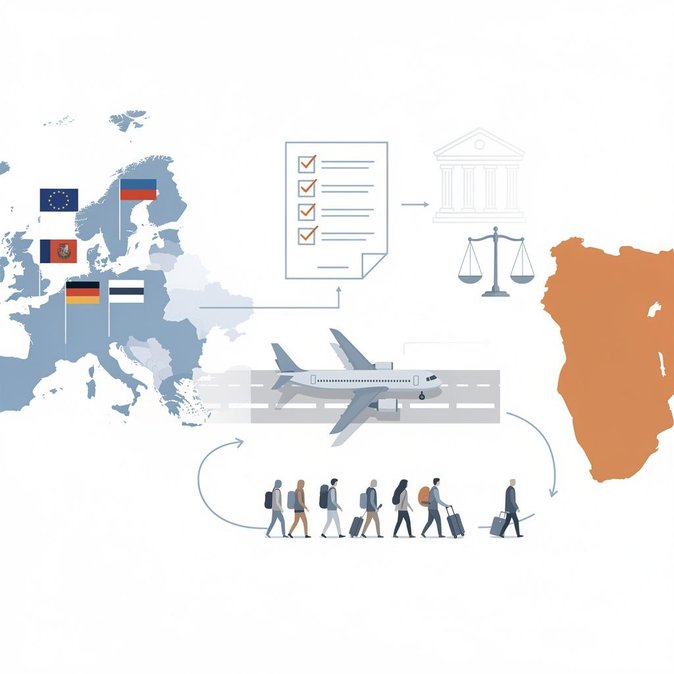
Austria’s Interior Minister Gerhard Karner has revealed that negotiations on a joint “return hub” in Rwanda are advancing faster than expected and that a memorandum of understanding could be signed as early as January or February 2027. Speaking in Vienna on 19 November, Karner said the first round of technical talks with Rwandan Interior Minister Vincent Biruta had already taken place on 17 November, immediately after five EU member states—Austria, Denmark, Germany, Greece and the Netherlands—publicly launched the initiative. Under the plan, migrants whose asylum claims have been rejected would be transferred to a processing centre in Rwanda while their deportation or resettlement is arranged. Karner framed the scheme as a “pilot project” that will relieve pressure on EU countries and could be copied by others if successful. The centre is expected to house about 100 people at a time, with each participating country initially sending roughly 20 returnees. Human-rights organisations have condemned the idea, citing the UK Supreme Court’s recent ruling that Rwanda is not a safe third country. Karner dismissed the criticism, saying the agreement will include robust monitoring and meet European Convention standards. He declined to discuss costs, after Austrian opposition parties claimed the programme could become a “tax-payer money pit.” For multinational employers, the development signals that Austria intends to continue hardening its removal policy; employees whose permits lapse or whose protection claims fail may face swifter transfers out of Europe. Companies should audit internal compliance and ensure timely renewal of Red-White-Red Cards and other residence titles. Meanwhile, the prospect of external processing may affect the calculus of would-be asylum seekers choosing their destination country. If the pact is signed on schedule, Austrian authorities foresee the first transfers taking place in the second half of 2027. Legal challenges are almost certain, but Karner insists the timeline is realistic and that the “Group of Implementers” will finalise operational details—including funding and oversight—within the next six months.