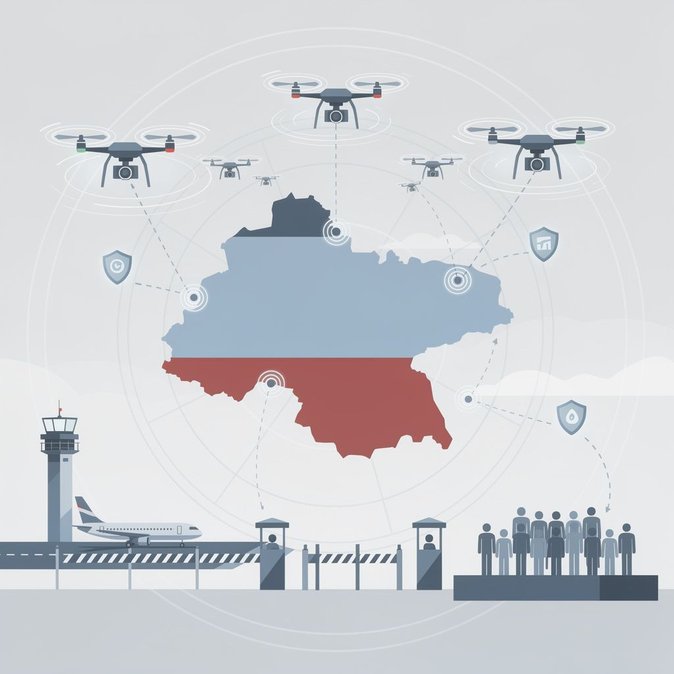
The Austrian Interior Ministry (BMI) today issued an aviso announcing that it will present the country’s first comprehensive ‘Gesamtstaatliche Drohnenschutzstrategie’ on 24 November. Developed jointly with the Defence Ministry and elite Cobra counter-terrorism unit, the plan sets out how civilian and military authorities will detect, track and neutralise hostile unmanned aerial vehicles (UAVs) at airports, border crossings and events. Although details remain under embargo, officials say the strategy integrates existing radio-frequency jamming kits deployed at Vienna-Schwechat and Innsbruck airports with new radar-optical sensor meshes along the Hungarian and Slovenian borders. A national command centre in Wien-Meidling will coordinate responses and maintain a live threat picture shared with Europol’s Drone Incidents Data Repository. Use-cases go beyond security. Customs officers will trial drone swarms to scan freight yards for radiation and contraband, while the Mountain Rescue Service will gain ‘blue-light corridors’ in alpine areas to speed up casualty evacuations. The framework also clarifies legal mandates, granting police on-site authority to ground drones that violate no-fly zones without a separate judicial order, and streamlining data-sharing with telecoms operators. For global-mobility managers the move signals tighter airspace control during high-profile events such as the Davos Forum trains via Tyrol or the Salzburg Festival. Charter operators of corporate drones must pre-register flight plans and install remote-ID beacons by mid-2027, six months earlier than the EU baseline. Failure to comply could lead to confiscation of equipment and fines up to €50,000. Stakeholders can submit comments during a four-week consultation starting the day of presentation. The ministries aim to pass enabling legislation by summer 2027, ahead of the full roll-out of the European U-space drone-traffic system.
Source: APA-OTS