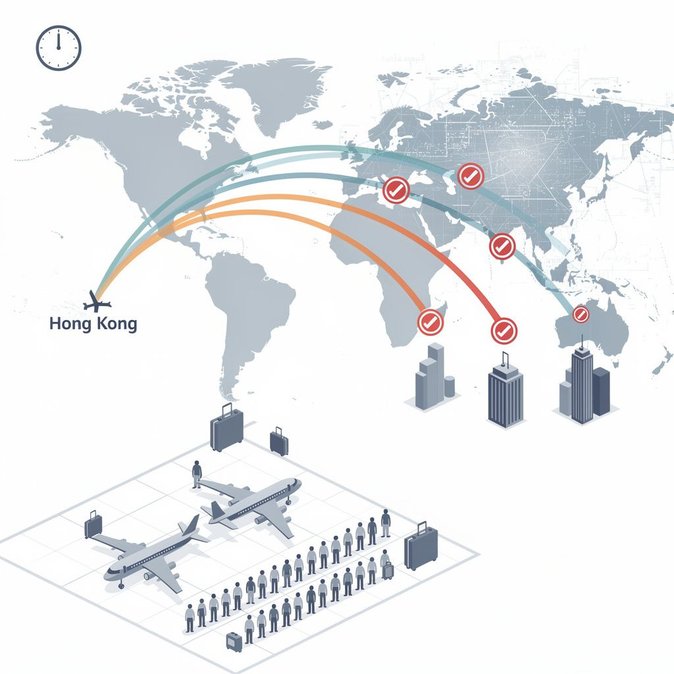
Hong Kong business travellers heading to or returning from the United States faced an unwelcome surprise on Friday after the cascading effects of last week’s rare, nationwide Federal Aviation Administration (FAA) ground-stop continued to ripple through airline schedules. According to Cathay Pacific and Airport Authority data cited by local media, 16 services linking Hong Kong International Airport with New York, Los Angeles, San Francisco and Chicago have been rescheduled or delayed over a 48-hour window from 20 November, while two flights were outright cancelled. The disruption stems from a six-hour shutdown of US air-traffic computers on 13 November—the longest ground-stop since 9/11—which created a backlog of more than 6,000 delayed aircraft. Although the FAA lifted restrictions the same day, airlines have spent the subsequent week repositioning crews and aircraft. Cathay Pacific told reporters that Thursday night’s CX830 to JFK was delayed 11 hours because the inbound aircraft and crew were held in Boston; Friday’s JFK and LAX departures left on time but the carrier warned of “knock-on congestion” at US gateways. Hong Kong’s other long-haul operator, United Airlines, re-timed two departures to allow for crew-rest compliance. For corporate mobility managers the timing could hardly be worse. The United States remains Hong Kong’s second-largest business-travel market and the 24 November US Thanksgiving holiday typically triggers a week-long surge in trans-Pacific traffic. Travel platforms Trip.com and FCM Travel said corporate itineraries through next Monday show load factors above 90 per cent, leaving little slack for reaccommodation if additional cancellations occur. Practically, firms are being advised to build 24-to-48-hour buffers around US itineraries, avoid tight domestic connections, and prepare documentation for duty-of-care reporting in case staff are stranded. Travellers connecting onward to Latin America or Europe via US hubs should consider rerouting through Vancouver or Dubai, both of which retain spare premium-cabin capacity this week. HR departments should also remind staff that visa waiver (ESTA) holders must still satisfy the United States’ proof-of-vaccination rules, which remain unchanged despite last week’s technical meltdown. Longer term, analysts say the incident underscores the fragility of ageing US air-traffic infrastructure. “Any systemic outage now reverberates globally within hours,” notes Brendan Sobie of Sobie Aviation. “Asia-based corporates with tight project timelines need contingency travel policies that assume North-American irregular operations several times per year.”
Source: South China Morning Post