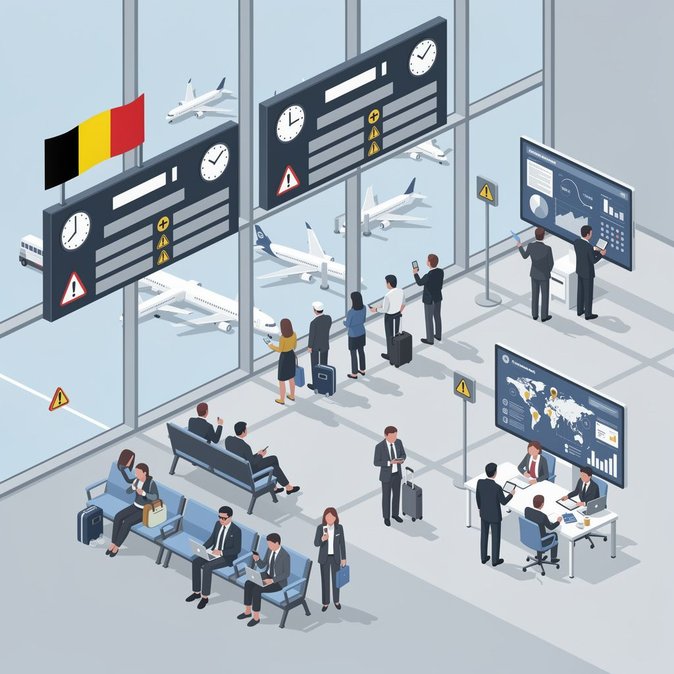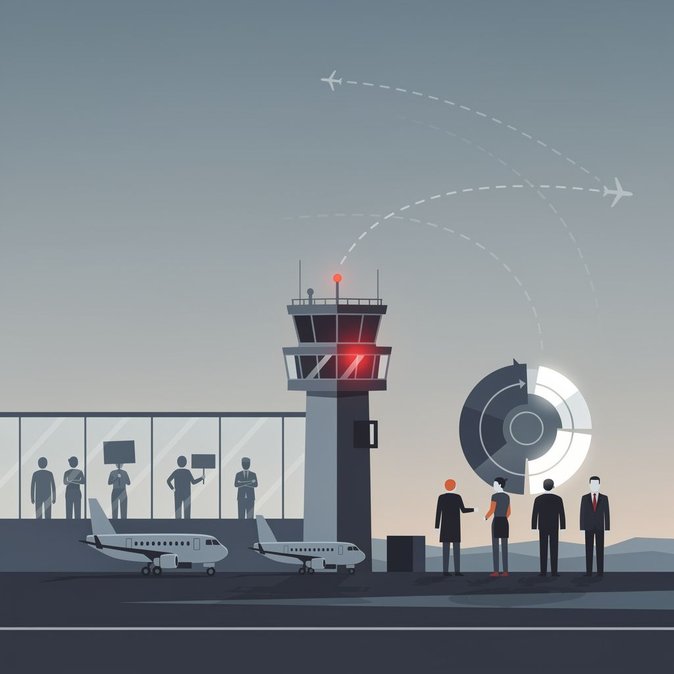
Stung by criticism over its late announcement of Monday’s airspace closure, Skeyes on Sunday issued an unusual public statement asking legislators to clarify how much advance warning unions must give when air-traffic controllers plan to strike. The company said it only received the first formal notice from staff representatives on Saturday morning, leaving too little time to organise contingency rosters or coordinate with airports and airlines. “Current Belgian labour law does not oblige air-traffic-control personnel to reveal their participation ahead of time,” Skeyes argued, adding that this legal vacuum makes it impossible to guarantee continuity even at reduced capacity. The firm therefore supports a statutory ‘minimum-service’ mechanism similar to those in France, Italy and Spain, where controllers must declare individually if they intend to work, enabling planners to maintain a limited but stable flow of aircraft. Airlines have echoed that demand. BAR Belgium points out that France, despite its reputation for frequent strikes, rarely shuts down its airspace entirely because DGAC’s minimum-service rules cap cancellations at roughly 30 % on a typical strike day. Belgium, by contrast, has seen 11 full closures in 2026 alone. Labour unions reject the comparison, noting that Belgian controllers already face staff shortages and that fragmenting the workforce into ‘strikers’ and ‘non-strikers’ exposes individuals to peer pressure. They accuse Skeyes management of using the dispute to deflect attention from slow recruitment and high overtime. Nevertheless, momentum for reform is building across party lines. Opposition liberal MR announced it will table its own bill if the government’s draft stalls, while the Flemish nationalist N-VA – normally sceptical of federal intervention – signalled support provided safety standards are not eroded.
Source: La Libre (via News Minimalist)