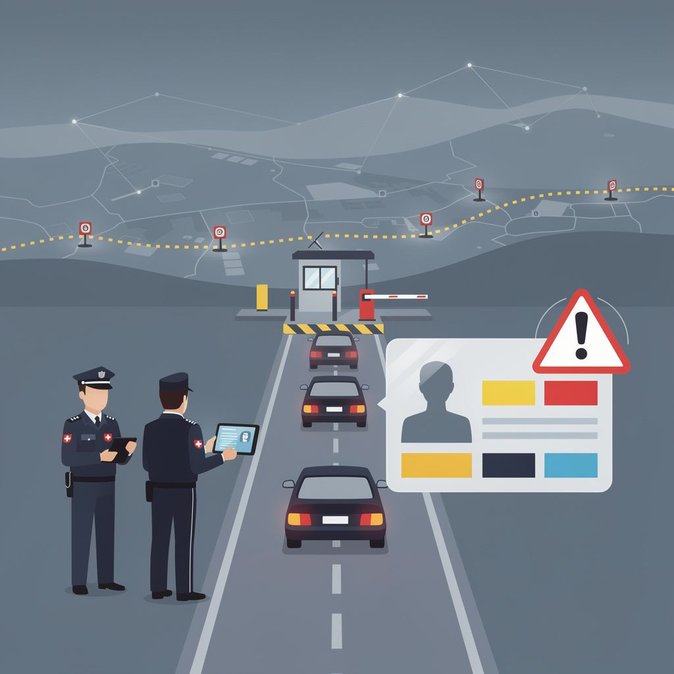
Ticino’s cantonal police and the Federal Office for Customs and Border Security (UDSC) have published results of a three-month series of joint controls along the Italian border in the Mendrisiotto district. Although the operation ran from September to November, the findings were only released on 21 November and immediately picked up by cross-border worker portal FrontaliereTicino. Across 43 surprise checkpoints on secondary roads linking Chiasso, Balerna and Stabio, officers inspected 461 vehicles and questioned 699 travellers. They uncovered 26 traffic offences, 17 customs violations, a forged identity document and a car with a hidden 1.5-gram cocaine stash. Three people wanted on outstanding warrants were taken into custody. Authorities said the goal was to disrupt property crime and people-smuggling routes that exploit the busy commuter corridor between Lombardy and southern Switzerland. The sweeps follow a noticeable uptick in petty theft and undocumented shuttle drivers reported by border towns since the EU Entry/Exit System went live in April. Because EES registration slows processing at major crossings, criminals have shifted to rural lanes, police say. By placing teams at unmarked lay-bys and village roundabouts, the task-force sought to create an unpredictable enforcement net. For the region’s 75 000 daily cross-border workers, the statistics offer both reassurance and a warning. While only 0.43 percent of people checked were fugitives, the presence of customs officers means even minor undeclared goods (e.g., duty-free fuel or online purchases) risk fines. Employers running shuttle buses should instruct drivers to carry manifests and expect random delays of up to 20 minutes per stop. Cantonal officials hinted at extending the model to the Leventina valley in early 2027. Businesses sourcing parts from northern Italy should therefore map alternative delivery windows or use authorised transit lanes where available.
Source: FrontaliereTicino