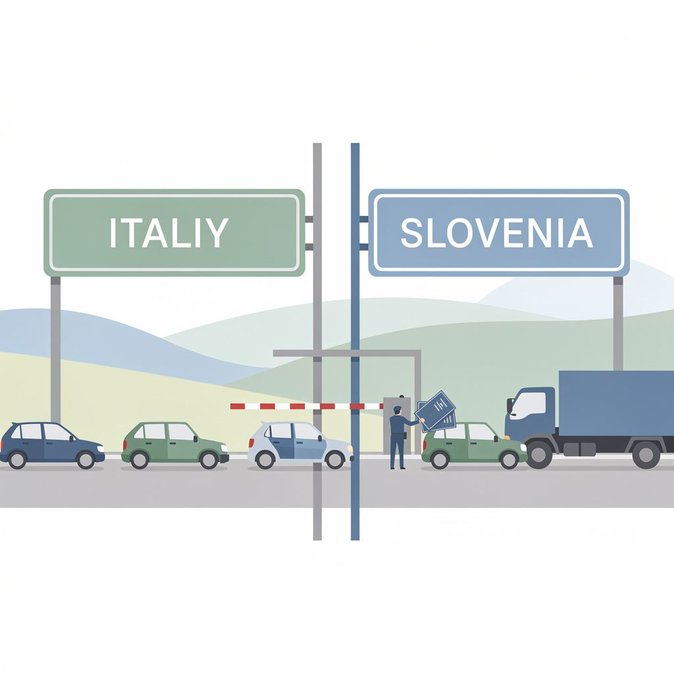
Italy has officially notified the European Commission that it will prolong the temporary re-introduction of controls at its internal land borders with Slovenia for another six-month period, from 19 December 2026 through 18 June 2027. The extension appears in the Commission’s updated Schengen Border Control register published late on 21 November. Rome cites an ongoing “continued threat of terrorist infiltrations into migratory flows along the Western Balkan route,” combined with the wars in the Middle East and Ukraine, and the high volume of irregular migration facilitated by organised smuggling networks as grounds for the measure. Italy’s checks on the 232-kilometre frontier were first reinstated in June 2026, following similar steps by Austria, Germany and France. Under the Schengen Borders Code, internal checks are meant to be exceptional and proportional, but Member States may renew them in six-month increments if serious threats persist. The latest notification brings the cumulative duration of Italy’s controls to a full year, edging closer to the two-year ceiling that normally applies. Firms moving goods between Trieste and Koper or shuttling staff between the Friuli-Venezia Giulia region and neighbouring Slovenia should therefore plan for continued document checks, sporadic traffic queues and carrier liability obligations. For business travellers, the practical impact has so far been limited to occasional waits of 10-40 minutes on the busiest crossing points, yet transport associations warn that any escalation of inspections could disrupt just-in-time supply chains, particularly for automotive components and farm-to-table perishables that rely on the border’s ‘green lanes’. Employers with commuters who live in one country and work in the other are advised to remind staff to carry passports or national ID cards and proof of residence or employment. The extension also signals that the Meloni government is unlikely to relax its broader security posture along the north-eastern corridor in the near term. Companies planning relocation or expatriate assignments that involve frequent cross-border travel between Italy and Central Europe should monitor subsequent Commission updates, as the next decision point will fall in May 2027, four weeks before the current authorisation expires.
Source: European Commission – DG HOME