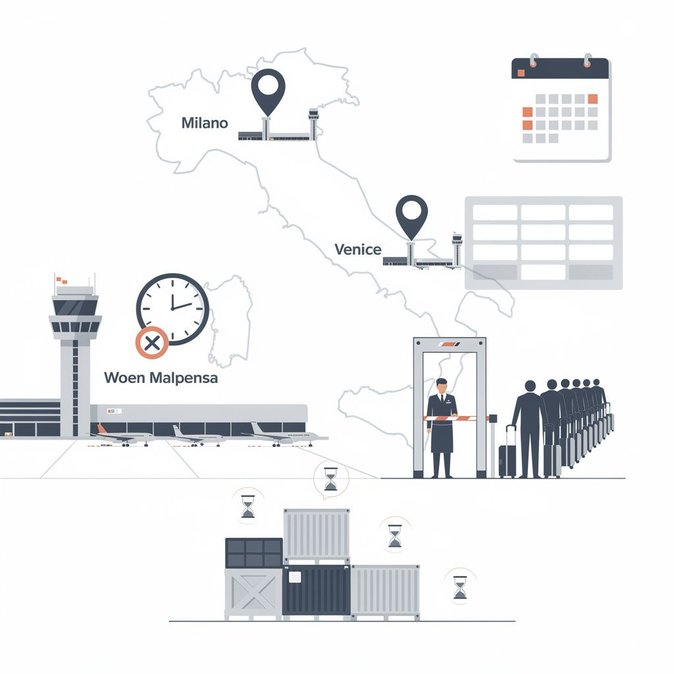
Italy’s delicate pre-Christmas travel season faced fresh turbulence on Sunday, 22 November, as separate labour actions hit two of the country’s busiest airports. ENAV air-traffic-control staff at Milan Malpensa (MXP) staged a four-hour local strike from 13:00 to 17:00, while security-screening personnel employed by Sicuritalia IVRI at Venice Marco Polo Airport (VCE) observed a 24-hour walkout. Strike-tracking portal Airspace Times reported the Malpensa stoppage early Sunday, confirming essential services but warning of potential knock-on delays to long-haul departures. The national strike calendar maintained by ScioperiItalia listed both actions, noting that the Venice stoppage had been rescheduled from mid-October. At Malpensa, contingency staffing kept one runway and selected approach sectors open, enabling priority flights—medical evacuations, military movements and at least 30 percent of scheduled commercial services—to operate. Nonetheless, airlines including easyJet and Emirates pre-emptively cancelled or rerouted several European feeders and intercontinental rotations, asking passengers to rebook. Freight forwarders reported delays to temperature-controlled cargo destined for the pharmaceutical hub in nearby Varese, and logistics operators shifted urgent consignments to Milan Linate or Zurich. The Venice walkout primarily affected outbound passenger screening. Although airlines could land, limited security lanes meant check-in queues spilled into the forecourt during the morning peak. Tour operators rerouted cruise passengers via Treviso and Trieste airports, adding two-to-three-hour coach transfers. The action underscores rising labour unrest in Italy’s transport sector following the 20 November nationwide general strike, and foreshadows a broader multi-sector stoppage announced for 4 December that may again include aviation staff. For corporate travel managers, the immediate takeaway is to maintain flexible ticketing policies through early December and to activate traveller-tracking tools on strike days. Employers with time-sensitive mobility moves—visa runs, assignee home-leaves or onboarding trips—should have contingency routings via Rome Fiumicino or regional hubs in neighbouring countries. Frequent cross-border commuters should also note that further ENAV notices could emerge with only 48-hour lead time under Italian law. Companies are advised to subscribe to official MIT strike bulletins and to brief employees on their EU Air Passenger Rights should cancellations trigger accommodation or reimbursement claims.