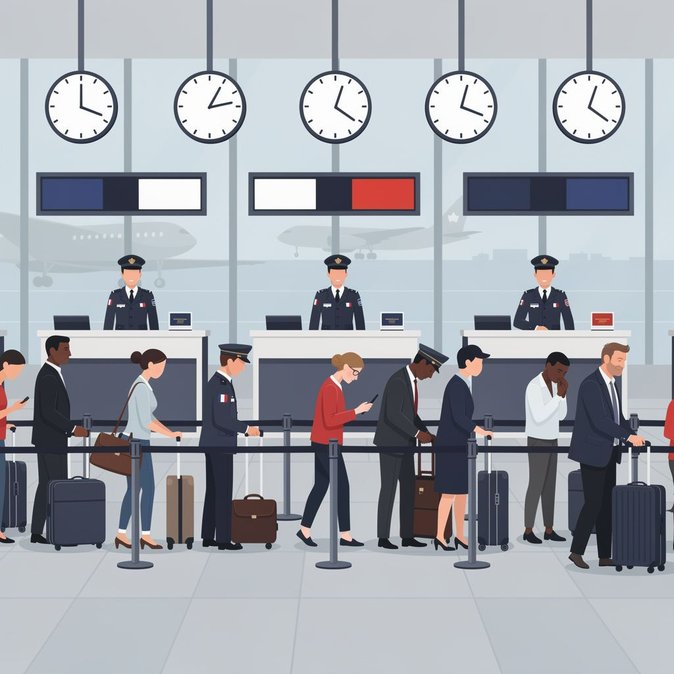
Travellers leaving France through Paris-Orly on Thursday morning faced queues stretching across the departures hall after members of the Police aux Frontières (PAF) staged a surprise “work-to-rule” to press pay demands. Officers belonging to the Alliance union manually checked every passport and scrutinised supporting documents, dramatically slowing flows at both Schengen-exit and third-country booths. The protest highlights how labour unrest in the security services can instantly disrupt international travel even when airlines and ground-handlers are operating normally. Large corporates reported staff missing onward connections in Madrid and Dubai; several tour groups re-routed via Charles-de-Gaulle after receiving alerts from their travel-risk providers. Unlike a formal strike, the slow-down did not trigger DGAC contingency staffing, leaving airlines responsible for managing frustrated passengers. Mobility managers are advised to monitor PAF industrial-relations bulletins: the Alliance union has warned that similar “targeted checks” could hit other Paris, Lyon and Nice terminals in the run-up to the Christmas peak. Under France’s internal-border-control regime, reinstated until at least 30 April 2027, officers already perform systematic checks on selected flights. Thursday’s action effectively turned that selective regime into 100 % control for several hours – a reminder that employers should factor in extra dwell time at French exit points, especially for non-EU assignees unfamiliar with Schengen stamping rules. Orly’s operator says normal throughput of 180 passengers per lane per hour fell to under 60 during the protest. While the airport cleared the backlog by early afternoon, the incident underscores the fragility of France’s border-control resourcing and the knock-on costs for time-critical cargo and executive travel.
Source: Le Parisien