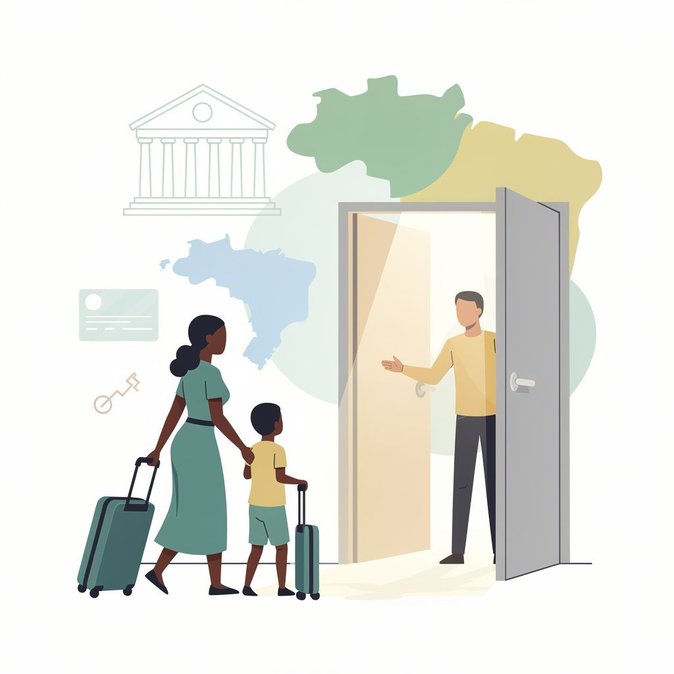
In a landmark decision for migrant family unity, the 4th Panel of Brazil’s Regional Federal Court of the 6th Region (TRF-6) confirmed on 27 November 2026 that the Brazilian government must allow the Haitian wife and minor son of a Haiti-born permanent resident to enter the country without first obtaining consular visas. The ruling, which rejected an appeal by the Federal Attorney-General’s Office, keeps in force a lower-court injunction that had authorised the pair to board a flight to Brazil on the strength of their passports and proof of family ties alone. The dispute stemmed from persistent backlogs at Brazilian consulates in Port-au-Prince and Santo Domingo, where appointment slots for the electronic family-reunification visa (created by Inter-ministerial Ordinance 55/2025 and amended by Ordinance 67/2026) have been virtually unavailable for months. Lawyers argued that forcing close relatives to wait indefinitely outside the country violated both Brazil’s 2017 Migration Law and constitutional protections of the family. The three-judge panel agreed, stressing that administrative difficulties cannot override the humanitarian purpose of the legislation. Brazil has become a crucial destination for Haitian migrants since the 2010 earthquake, with an estimated 170 000 Haitians now living in the country. While the 2023 humanitarian visa programme for Haitians was folded into a broader framework in 2026, family-reunification visas remain available—at least in theory—through Brazil’s e-Consular platform. In practice, however, technical glitches and staffing shortages have left many families in limbo. The TRF-6 ruling acknowledges this reality and sets a precedent that other courts may follow when consular channels fail to function. For multinational companies employing Haitian talent in Brazil—particularly in construction, agribusiness and logistics—the judgment offers welcome clarity. Dependants who are stuck abroad can invoke the decision to expedite travel and regularise their status once in Brazil, reducing disruption to assignees’ productivity and wellbeing. Employers should still monitor each case carefully: the court made clear that its order applies where family links are proven and no public-health or security impediments exist. Practically, global mobility managers should update their checklists: if employees’ spouses or children are Haitian nationals facing long consular waits, legal counsel may petition local federal courts for similar relief. Meanwhile, compliance teams should advise arriving family members to present themselves to the Federal Police within 90 days to convert their entry stamp into the appropriate residence permit. The Ministry of Justice and the Ministry of Foreign Affairs have yet to comment, but pressure is likely to mount for a systemic fix—potentially an expansion of automatic visa waivers for close relatives or a fast-track e-visa lane. Until then, court intervention remains the most effective remedy for separated Haitian families.
Source: IBDFAM