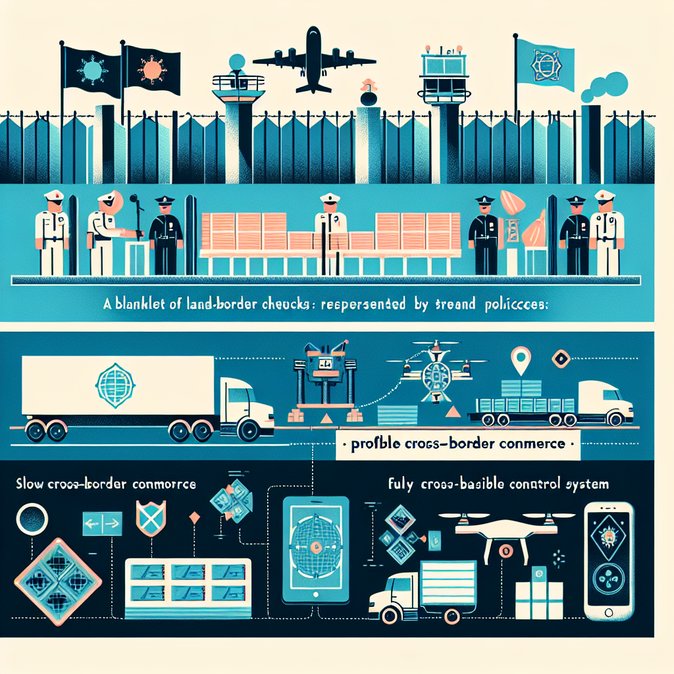
Speaking to dpa on 13 January, Federal Police Ombudsperson Uli Grötsch criticised Germany’s blanket stationary checks at all nine land borders and urged a shift toward ‘flexible, intelligence-led’ controls that leverage automatic number-plate recognition, drones and mobile patrols. Since September 2024 the Bundespolizei has run fixed checkpoints on road and rail crossings with Austria, Czechia, Poland, Switzerland and, more recently, Denmark, France, Belgium, Luxembourg and the Netherlands.
Grötsch acknowledged that the policy—extended repeatedly by Interior Minister Alexander Dobrindt—has halved detected irregular entries (from 127,549 in 2023 to 62,526 in 2025) but argued that one-size-fits-all roadblocks drain manpower and create hardship for officers posted to remote cabins with limited facilities. He cited Schirnding on the Czech frontier, where personnel still rely on mobile toilets despite winter conditions.
![Federal Police Ombudsperson Calls for Smarter, Tech-Driven Border Controls]()
From a corporate-mobility perspective, continued spot checks mean travellers must carry passports, proof of accommodation and, where relevant, evidence of funds even on intra-Schengen itineraries. Logistics firms report delays on just-in-time supply routes, while cross-border commuters complain of unpredictable hold-ups that complicate work-schedule planning.
Grötsch’s comments will feed into Berlin’s upcoming risk-assessment report to the European Commission, due in February, which must justify prolonging internal-Schengen controls beyond the current 15 March 2026 deadline. Businesses are lobbying for clearer notice periods, electronic pre-clearance options and harmonised procedures across Germany’s nine frontiers.
While an immediate end to checks is “not in sight”, Grötsch said, smarter deployment of technology could let officers target smugglers more precisely while easing pressure on legitimate travellers—a sentiment echoed by chambers of commerce in Bavaria and Saxony that see flexible controls as essential to regional competitiveness.
Grötsch acknowledged that the policy—extended repeatedly by Interior Minister Alexander Dobrindt—has halved detected irregular entries (from 127,549 in 2023 to 62,526 in 2025) but argued that one-size-fits-all roadblocks drain manpower and create hardship for officers posted to remote cabins with limited facilities. He cited Schirnding on the Czech frontier, where personnel still rely on mobile toilets despite winter conditions.

From a corporate-mobility perspective, continued spot checks mean travellers must carry passports, proof of accommodation and, where relevant, evidence of funds even on intra-Schengen itineraries. Logistics firms report delays on just-in-time supply routes, while cross-border commuters complain of unpredictable hold-ups that complicate work-schedule planning.
Grötsch’s comments will feed into Berlin’s upcoming risk-assessment report to the European Commission, due in February, which must justify prolonging internal-Schengen controls beyond the current 15 March 2026 deadline. Businesses are lobbying for clearer notice periods, electronic pre-clearance options and harmonised procedures across Germany’s nine frontiers.
While an immediate end to checks is “not in sight”, Grötsch said, smarter deployment of technology could let officers target smugglers more precisely while easing pressure on legitimate travellers—a sentiment echoed by chambers of commerce in Bavaria and Saxony that see flexible controls as essential to regional competitiveness.
Source: DIE ZEIT / dpa