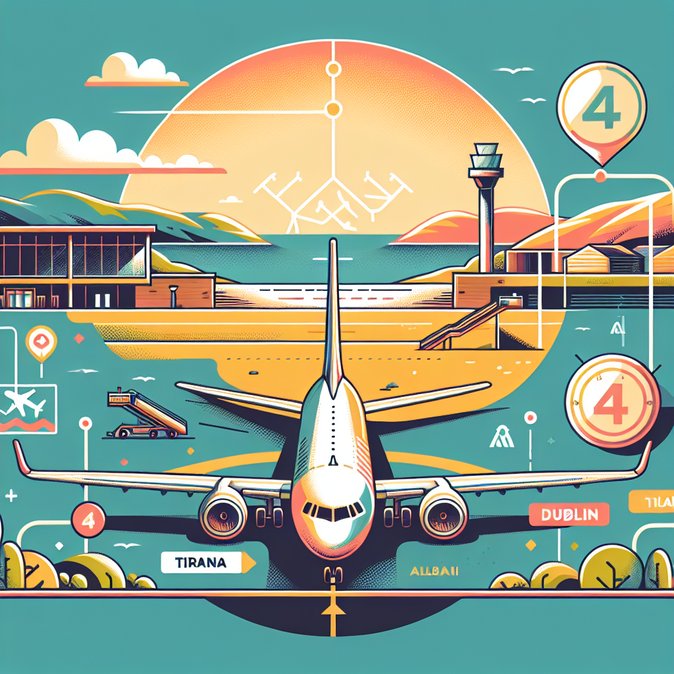
Ryanair has chosen Albania as its next growth engine, confirming on 20 January that it will station a fourth Boeing 737-800 in Tirana from April 2026 and open 20 new routes—Dublin among them—for the Summer 2026 season. The move represents a US$400 million investment and will lift the Irish carrier’s Tirana network to 43 destinations, pushing annual traffic to four million passengers, a 50 % jump year-on-year.
The expansion underscores a strategic pivot toward non-EU markets that offer low aviation taxes. Albania scrapped its passenger-flight tax last year, allowing Ryanair to undercut legacy rivals by up to 30 %. For Irish corporates with manufacturing or IT partners in the Western Balkans, the nonstop Dublin–Tirana service cuts door-to-door journey times by at least three hours compared with one-stop itineraries via Vienna or Rome.
![Ryanair to launch 20 new routes from Tirana, including Dublin link, in US$400 m Albanian expansion]()
Albania’s government hopes the added capacity will accelerate FDI inflows. According to the Albanian Investment Development Agency, Irish and UK firms have already earmarked €120 million for near-shore software hubs in Tirana and Durres. Easier air links will also help Irish agritech exporters tapping Albania’s fast-growing retail sector, which posted 14 % year-on-year expansion in 2025.
Ryanair says the Tirana base will ultimately grow to six aircraft by 2030, supporting over 4,000 local jobs. The airline has launched a three-day sale with 100,000 seats from €29.99 to stimulate early demand. Mobility managers should flag that the route will be summer-seasonal at first; winter continuity will depend on load-factor performance.
From a policy perspective, the announcement pressures Dublin Airport, which is still subject to a 32-million passenger cap, to facilitate further long-thin point-to-point routes. Failure to relax the cap could see Ryanair base new aircraft elsewhere, diluting Ireland’s connectivity dividend.
The expansion underscores a strategic pivot toward non-EU markets that offer low aviation taxes. Albania scrapped its passenger-flight tax last year, allowing Ryanair to undercut legacy rivals by up to 30 %. For Irish corporates with manufacturing or IT partners in the Western Balkans, the nonstop Dublin–Tirana service cuts door-to-door journey times by at least three hours compared with one-stop itineraries via Vienna or Rome.

Albania’s government hopes the added capacity will accelerate FDI inflows. According to the Albanian Investment Development Agency, Irish and UK firms have already earmarked €120 million for near-shore software hubs in Tirana and Durres. Easier air links will also help Irish agritech exporters tapping Albania’s fast-growing retail sector, which posted 14 % year-on-year expansion in 2025.
Ryanair says the Tirana base will ultimately grow to six aircraft by 2030, supporting over 4,000 local jobs. The airline has launched a three-day sale with 100,000 seats from €29.99 to stimulate early demand. Mobility managers should flag that the route will be summer-seasonal at first; winter continuity will depend on load-factor performance.
From a policy perspective, the announcement pressures Dublin Airport, which is still subject to a 32-million passenger cap, to facilitate further long-thin point-to-point routes. Failure to relax the cap could see Ryanair base new aircraft elsewhere, diluting Ireland’s connectivity dividend.