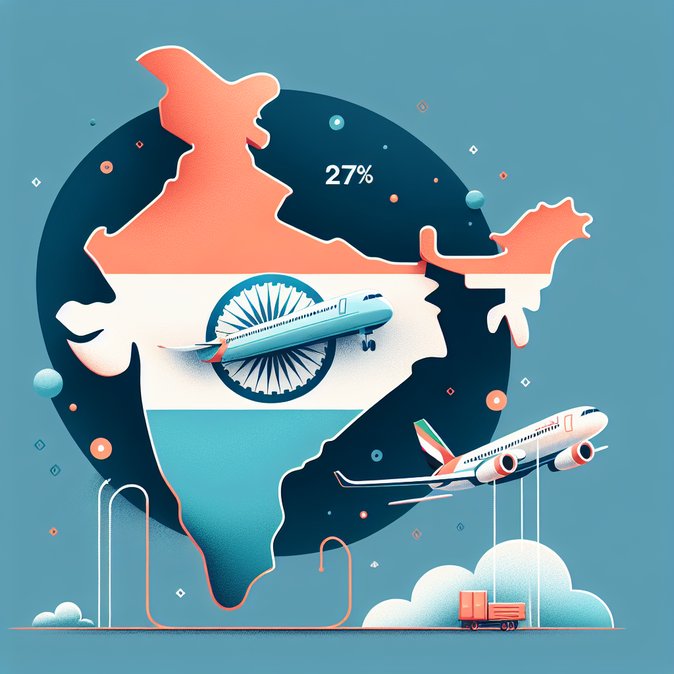
Just as Dubai Airports celebrates record passenger flows, a new Tourism Economics white paper has sounded the alarm: existing bilateral caps on flights and seats between India and the United Arab Emirates risk leaving one in four travellers stranded by 2035. Released on 23 January, the study projects that demand on the corridor – already the world’s busiest by O-D traffic – will grow 7 percent a year, yet available capacity could be exhausted as early as next year. (m.economictimes.com)
Under today’s air-services agreement, airlines on both sides share roughly 140,000 weekly seats. Load factors on trunk routes such as Abu Dhabi–Delhi already average above 85 percent, and low-fare inventory often disappears months out. The report estimates that maintaining the status quo would leave 54 million passenger journeys unserved between 2026 and 2035, shaving AED 26 billion off potential GDP gains linked to tourism and trade.
![Study warns India-UAE air corridor could run out of seats by 2026 unless capacity caps are lifted]()
For companies managing executive travel, tighter availability means higher fares, reduced flexibility and longer booking lead times. Corporates with operations in India’s Tier-2 cities could face particular pain as they rely on connections through Dubai, Sharjah or Abu Dhabi. The study argues that doubling seat entitlements – particularly on the Abu Dhabi–India sector – could unlock an extra AED 26 billion in GDP over five years and support 170,000 jobs.
Policy options include renegotiating bilateral quotas, granting more fifth-freedom rights, or accelerating airport-slot expansions at Mumbai and Delhi. Abu Dhabi’s new Terminal A and Dubai’s planned DWC mega-hub both have the physical capacity, but political will is needed. Aviation analysts expect talks to resume after India’s general election later this year; meanwhile, carriers such as SpiceJet and Air India Express are adding point-to-point services to secondary UAE airports to ease pressure.
Travel managers should monitor fare trends and consider advance-purchase strategies for 2026 peak seasons. Relocation teams moving talent between the two countries may also need to adjust assignment budgets as airfare inflation feeds into cost-of-living packages.
Under today’s air-services agreement, airlines on both sides share roughly 140,000 weekly seats. Load factors on trunk routes such as Abu Dhabi–Delhi already average above 85 percent, and low-fare inventory often disappears months out. The report estimates that maintaining the status quo would leave 54 million passenger journeys unserved between 2026 and 2035, shaving AED 26 billion off potential GDP gains linked to tourism and trade.

For companies managing executive travel, tighter availability means higher fares, reduced flexibility and longer booking lead times. Corporates with operations in India’s Tier-2 cities could face particular pain as they rely on connections through Dubai, Sharjah or Abu Dhabi. The study argues that doubling seat entitlements – particularly on the Abu Dhabi–India sector – could unlock an extra AED 26 billion in GDP over five years and support 170,000 jobs.
Policy options include renegotiating bilateral quotas, granting more fifth-freedom rights, or accelerating airport-slot expansions at Mumbai and Delhi. Abu Dhabi’s new Terminal A and Dubai’s planned DWC mega-hub both have the physical capacity, but political will is needed. Aviation analysts expect talks to resume after India’s general election later this year; meanwhile, carriers such as SpiceJet and Air India Express are adding point-to-point services to secondary UAE airports to ease pressure.
Travel managers should monitor fare trends and consider advance-purchase strategies for 2026 peak seasons. Relocation teams moving talent between the two countries may also need to adjust assignment budgets as airfare inflation feeds into cost-of-living packages.
Source: The Economic Times