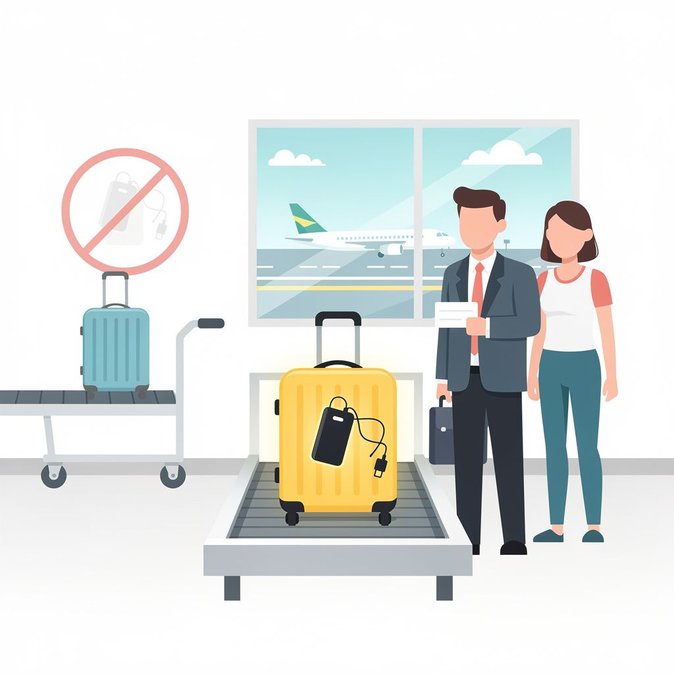
Travellers passing through Londrina Airport this morning were greeted by bright yellow posters showing a crossed-out battery icon – the local face of Brazil’s new nationwide restrictions on power banks in air transport. Instrução Suplementar 175, issued by aviation regulator ANAC on 6 April 2026, lowers the maximum capacity of lithium-ion power banks that may be carried in hand luggage from 32 000 mAh to 20 000 mAh and keeps the longstanding ban on placing them in checked bags.
While most people turn to VisaHQ for fast visa and passport processing, the service’s Brazil hub (https://www.visahq.com/brazil/) also alerts travellers to ancillary rules such as ANAC’s updated battery limits, offering a single place to confirm entry paperwork and on-the-ground regulations before flying.
Airport operations supervisor Cícero Valente told regional news portal Londrix that nearly one in five passengers carries a power bank. Security agents (APACs) have therefore been instructed to ask travellers to remove the devices from backpacks for separate X-ray screening, similar to laptops. Any unit that exceeds the new watt-hour limit, shows swelling or lacks a readable capacity label must be surrendered. Airlines must report confiscations and battery incidents to ANAC within 48 hours. The rule change follows a 27 % year-on-year rise in on-board battery-related smoke events across Brazilian carriers. In the most serious case, a device ignited in an overhead bin on a flight between Recife and Brasília in February, forcing an emergency descent. For frequent business travellers the practical impact is twofold: audit the capacity of promotional power banks often distributed at trade shows, and ensure devices remain in carry-on even on tight connections where gate agents may offer voluntary gate-check of bags. Corporate travel policies should be updated, and procurement teams sourcing branded power banks for marketing giveaways must stay under the 20 000 mAh ceiling.
While most people turn to VisaHQ for fast visa and passport processing, the service’s Brazil hub (https://www.visahq.com/brazil/) also alerts travellers to ancillary rules such as ANAC’s updated battery limits, offering a single place to confirm entry paperwork and on-the-ground regulations before flying.
Airport operations supervisor Cícero Valente told regional news portal Londrix that nearly one in five passengers carries a power bank. Security agents (APACs) have therefore been instructed to ask travellers to remove the devices from backpacks for separate X-ray screening, similar to laptops. Any unit that exceeds the new watt-hour limit, shows swelling or lacks a readable capacity label must be surrendered. Airlines must report confiscations and battery incidents to ANAC within 48 hours. The rule change follows a 27 % year-on-year rise in on-board battery-related smoke events across Brazilian carriers. In the most serious case, a device ignited in an overhead bin on a flight between Recife and Brasília in February, forcing an emergency descent. For frequent business travellers the practical impact is twofold: audit the capacity of promotional power banks often distributed at trade shows, and ensure devices remain in carry-on even on tight connections where gate agents may offer voluntary gate-check of bags. Corporate travel policies should be updated, and procurement teams sourcing branded power banks for marketing giveaways must stay under the 20 000 mAh ceiling.