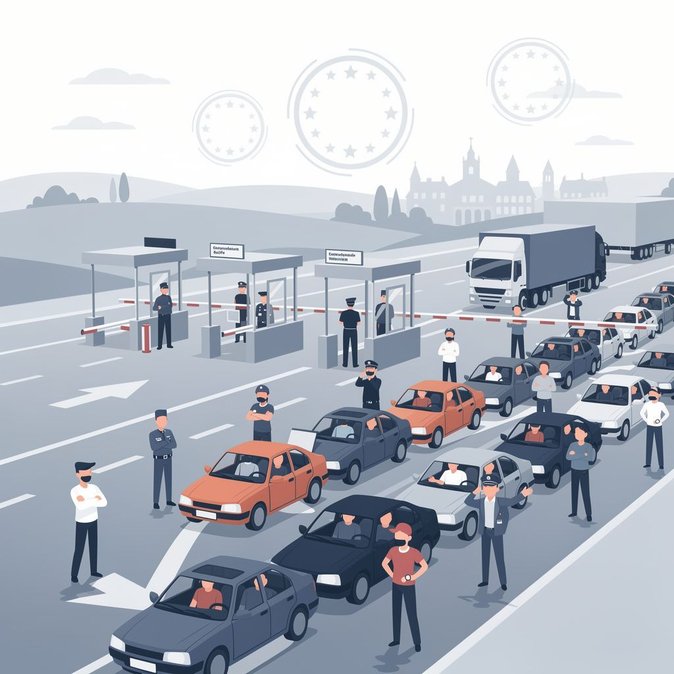
Hours after the EU’s new asylum rules took effect, residents and officials in Germany’s border state of Rhineland-Palatinate expressed disappointment that federal authorities are keeping controls in place. In a report broadcast by SWR Aktuell at 05:00 on 12 June 2026, daily commuters described queues of up to four kilometres at the Lauterbourg (FR)-Germersheim crossing.
Travellers and employers affected by the continued checks may find practical support through VisaHQ, whose platform (https://www.visahq.com/germany/) offers real-time guidance on German entry requirements, visa options, and document preparation. By streamlining applications and clarifying what paperwork border guards may request, VisaHQ helps commuters, tourists, and logistics firms minimise delays and plan cross-border movements with greater confidence.
The border checks were introduced in 2024 to deter irregular migration and were expected to lapse once the Common European Asylum System standardised screening at the EU’s external borders. Instead, the Interior Ministry says a “proof-of-concept phase” is needed to confirm that GEAS reduces onward movements before controls can be lifted. Local businesses warn that the uncertainty is affecting hiring. French workers who fill skills shortages in the Palatinate chemical cluster have begun seeking jobs closer to home to avoid unpredictable wait times. Exporters shipping just-in-time components to Alsace automotive plants report higher freight costs as hauliers add buffer time. The state government in Mainz is urging Berlin to publish objective criteria for ending the controls, arguing that permanent spot checks violate the spirit of Schengen and undermine regional labour mobility. Opposition conservatives counter that security must come first and point to a 28 percent increase in prevented illegal entries reported by the Federal Police in the first quarter. With tourist traffic set to rise during the summer holiday season, pressure is mounting for a political compromise that balances the economic interests of border regions with national security aims.
Travellers and employers affected by the continued checks may find practical support through VisaHQ, whose platform (https://www.visahq.com/germany/) offers real-time guidance on German entry requirements, visa options, and document preparation. By streamlining applications and clarifying what paperwork border guards may request, VisaHQ helps commuters, tourists, and logistics firms minimise delays and plan cross-border movements with greater confidence.
The border checks were introduced in 2024 to deter irregular migration and were expected to lapse once the Common European Asylum System standardised screening at the EU’s external borders. Instead, the Interior Ministry says a “proof-of-concept phase” is needed to confirm that GEAS reduces onward movements before controls can be lifted. Local businesses warn that the uncertainty is affecting hiring. French workers who fill skills shortages in the Palatinate chemical cluster have begun seeking jobs closer to home to avoid unpredictable wait times. Exporters shipping just-in-time components to Alsace automotive plants report higher freight costs as hauliers add buffer time. The state government in Mainz is urging Berlin to publish objective criteria for ending the controls, arguing that permanent spot checks violate the spirit of Schengen and undermine regional labour mobility. Opposition conservatives counter that security must come first and point to a 28 percent increase in prevented illegal entries reported by the Federal Police in the first quarter. With tourist traffic set to rise during the summer holiday season, pressure is mounting for a political compromise that balances the economic interests of border regions with national security aims.