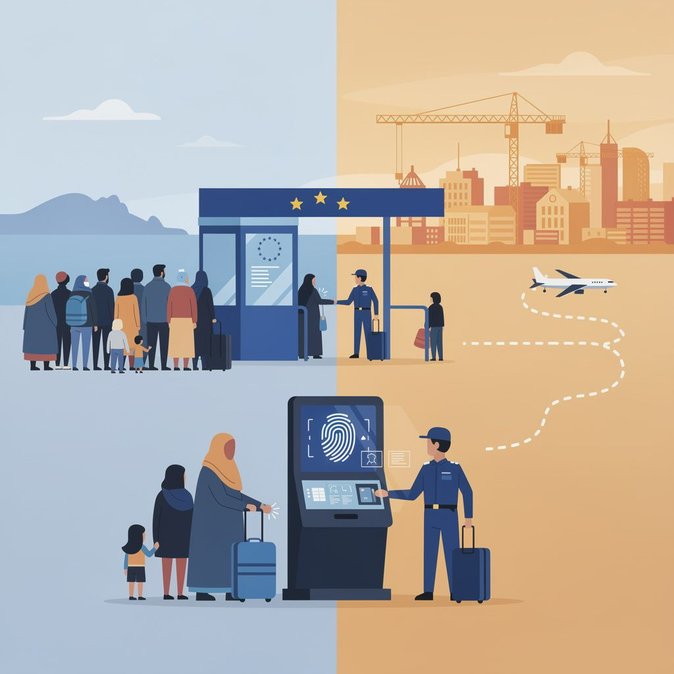
The European Union’s long-debated Migration and Asylum Pact became legally binding on 12 June, ushering in the tightest external-border rules in the bloc’s history. Writing from Brussels, EU Home Affairs Commissioner Magnus Brunner said the regulations ‘put Europe’s house in order’ by combining stricter identity checks, a unified list of safe countries, and accelerated deportations. Spain—along with Italy, Greece and Cyprus—is expected to be a primary test bed, as its land and maritime borders handle a high share of irregular arrivals. Key elements now live include a compulsory biometric Entry/Exit System (EES) for all non-EU travellers and an interoperable Eurodac database that will store data on children as young as six rather than the previous age of 14.
For travellers and global mobility teams trying to navigate these changes, VisaHQ offers real-time visa assessments, document checklists, and appointment scheduling for Spain, while also providing updates on the new EES procedures. Their online portal (https://www.visahq.com/spain/) consolidates embassy requirements and biometric standards in one place, helping companies and individuals remain compliant as EU border controls tighten.
Airlines serving Spain must transmit passenger data earlier, and transport companies that facilitate unauthorised entry risk fines of up to €40,000 per person. Civil-society groups warn the pact erodes asylum rights; Brunner counters that faster screening will free capacity for legal labour migration. Business lobbies in Spain are cautiously optimistic: the Confederación Española de Organizaciones Empresariales (CEOE) believes harmonised procedures could speed recruitment of seasonal farm workers and highly qualified tech talent once the initial learning curve passes. One flash point is the optional creation of off-shore ‘return centres’ in non-EU countries. Madrid has categorically rejected the model, calling it legally dubious, yet may face pressure if neighbouring states adopt it and see irregular flows diverted to Spain. Mobility managers should follow developments as they could affect family-reunification time-lines and humanitarian postings. Companies sending staff across the Strait of Gibraltar, or relocating employees from Latin America via Madrid, should brief travellers on longer border processing times and ensure passports have at least two blank pages for EES stamps until kiosks become fully automated later this year.
For travellers and global mobility teams trying to navigate these changes, VisaHQ offers real-time visa assessments, document checklists, and appointment scheduling for Spain, while also providing updates on the new EES procedures. Their online portal (https://www.visahq.com/spain/) consolidates embassy requirements and biometric standards in one place, helping companies and individuals remain compliant as EU border controls tighten.
Airlines serving Spain must transmit passenger data earlier, and transport companies that facilitate unauthorised entry risk fines of up to €40,000 per person. Civil-society groups warn the pact erodes asylum rights; Brunner counters that faster screening will free capacity for legal labour migration. Business lobbies in Spain are cautiously optimistic: the Confederación Española de Organizaciones Empresariales (CEOE) believes harmonised procedures could speed recruitment of seasonal farm workers and highly qualified tech talent once the initial learning curve passes. One flash point is the optional creation of off-shore ‘return centres’ in non-EU countries. Madrid has categorically rejected the model, calling it legally dubious, yet may face pressure if neighbouring states adopt it and see irregular flows diverted to Spain. Mobility managers should follow developments as they could affect family-reunification time-lines and humanitarian postings. Companies sending staff across the Strait of Gibraltar, or relocating employees from Latin America via Madrid, should brief travellers on longer border processing times and ensure passports have at least two blank pages for EES stamps until kiosks become fully automated later this year.