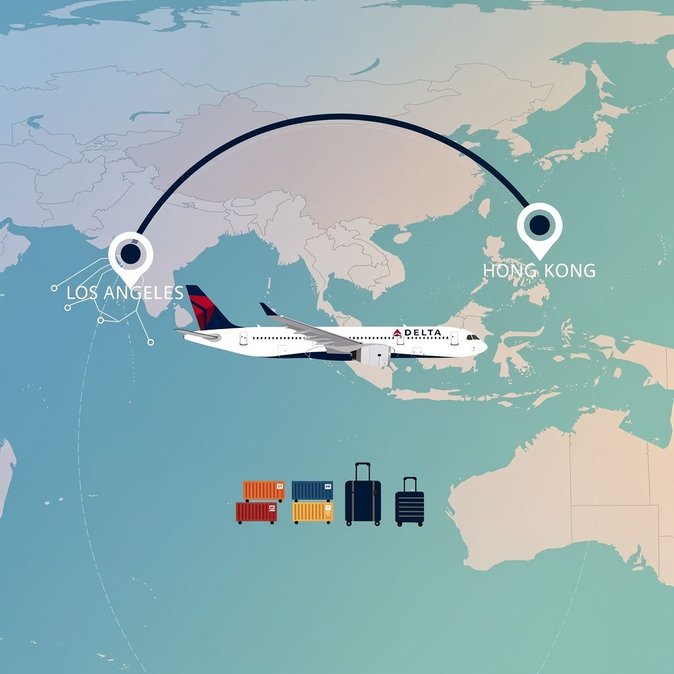
For the first time in eight years, a Delta Air Lines aircraft bearing the widget tail has touched down in Hong Kong. On 6 June the US carrier inaugurated a daily Airbus A350-900 flight between Los Angeles International Airport (LAX) and Hong Kong International Airport (HKG); the route entered regular operation this week and was formally celebrated on 11 June. The overnight westbound service departs LAX late evening and arrives in Hong Kong early morning, giving business travellers same-day access to destinations across mainland China, Taiwan and Southeast Asia.
Travellers who need help arranging visas for Hong Kong—or for onward journeys across Asia—can streamline the paperwork with VisaHQ. Its dedicated Hong Kong portal (https://www.visahq.com/hong-kong/) provides real-time entry requirements, online applications and courier support, ensuring frequent flyers spend less time on formalities and more time on business.
Eastbound, the flight leaves Hong Kong mid-afternoon for a daytime arrival in California, slotting into Delta’s domestic evening banks. With more than 30 one-stop connections beyond Los Angeles, the airline is positioning LAX as a springboard into Asia for corporate clients headquartered in the Western United States. Delta’s flagship A350 offers 306 seats across four cabins—Delta One suites, Premium Select, Comfort+ and Main Cabin—plus 20 tonnes of belly-hold cargo capacity. The mixed revenue streams are important on a 7 200-nautical-mile sector where fuel still accounts for roughly 35 percent of operating cost. Freight forwarders in Hong Kong welcome the additional lift for high-value electronics and e-commerce, while travel buyers gain a SkyTeam alternative to existing Cathay Pacific and United Airlines services. Analysts expect pricing pressure as three carriers now battle for premium loyalty on one of the Pacific’s busiest corporate corridors. Early indications are that Delta has entered with introductory fares some 8-10 percent below the incumbents’ fully flexible business-class levels, seeking to win share before the autumn conference season. The move reinforces Delta’s multibillion-dollar investment in LAX, where the carrier has opened a dedicated Delta One Lounge and consolidated international operations in the remodeled Terminal 3/Sky Way complex. For Hong Kong, the additional frequency supports the SAR government’s goal of restoring pre-pandemic connectivity and diversifying airline partners after several years of reduced long-haul capacity.
Travellers who need help arranging visas for Hong Kong—or for onward journeys across Asia—can streamline the paperwork with VisaHQ. Its dedicated Hong Kong portal (https://www.visahq.com/hong-kong/) provides real-time entry requirements, online applications and courier support, ensuring frequent flyers spend less time on formalities and more time on business.
Eastbound, the flight leaves Hong Kong mid-afternoon for a daytime arrival in California, slotting into Delta’s domestic evening banks. With more than 30 one-stop connections beyond Los Angeles, the airline is positioning LAX as a springboard into Asia for corporate clients headquartered in the Western United States. Delta’s flagship A350 offers 306 seats across four cabins—Delta One suites, Premium Select, Comfort+ and Main Cabin—plus 20 tonnes of belly-hold cargo capacity. The mixed revenue streams are important on a 7 200-nautical-mile sector where fuel still accounts for roughly 35 percent of operating cost. Freight forwarders in Hong Kong welcome the additional lift for high-value electronics and e-commerce, while travel buyers gain a SkyTeam alternative to existing Cathay Pacific and United Airlines services. Analysts expect pricing pressure as three carriers now battle for premium loyalty on one of the Pacific’s busiest corporate corridors. Early indications are that Delta has entered with introductory fares some 8-10 percent below the incumbents’ fully flexible business-class levels, seeking to win share before the autumn conference season. The move reinforces Delta’s multibillion-dollar investment in LAX, where the carrier has opened a dedicated Delta One Lounge and consolidated international operations in the remodeled Terminal 3/Sky Way complex. For Hong Kong, the additional frequency supports the SAR government’s goal of restoring pre-pandemic connectivity and diversifying airline partners after several years of reduced long-haul capacity.