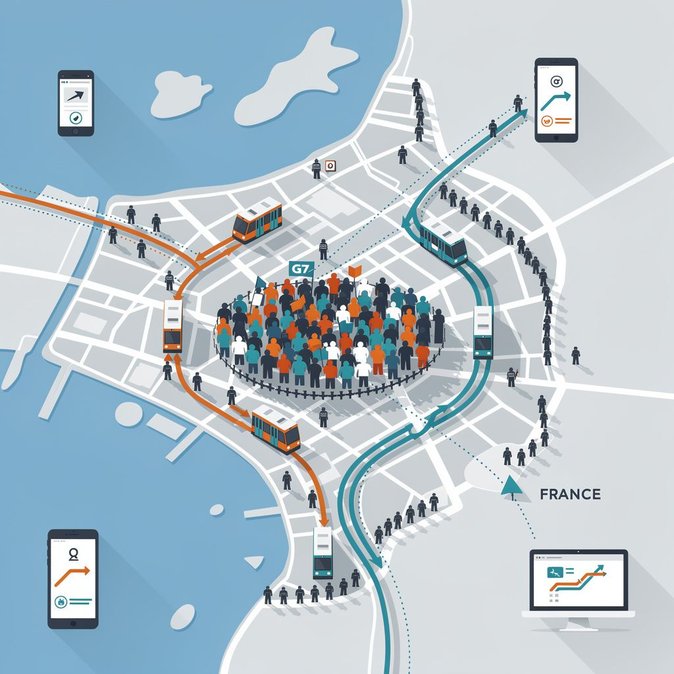
What began as a symbolic overlap between Switzerland’s annual Feminist Strike Day and anti-G7 activism quickly turned into a logistical puzzle for mobility planners on Sunday, 14 June. Geneva authorities authorised a 5-kilometre march from Quai Wilson to Parc Mon-Repos, but the demonstration—expected to draw 12 000 protesters—forced the closure or diversion of eleven bus and tram routes that normally continue into France.
Travellers affected by such cross-border disruptions may also need to ensure their travel documents and work permissions remain valid. VisaHQ’s France portal (https://www.visahq.com/france/) helps commuters, HR teams, and frequent travellers quickly verify visa requirements, secure extensions, and arrange transit permits, so that unexpected route changes don’t translate into administrative headaches.
Transports publics genevois (TPG) issued an extraordinary timetable: cross-border bus lines F, G and Y suspended service after noon, while the Léman Express truncated L1 and L2 services at La Plaine. French commuters who live in the Pays de Gex or work in Geneva’s international organisations faced 60- to 90-minute detours via Annemasse. Ride-hailing platforms applied surge pricing of up to 3.5× between 14:00 and 20:00, according to mobility-data start-up Kayrós. On the French side, the Préfecture of Haute-Savoie instructed companies with posted workers in Switzerland to activate remote-work plans or stagger shifts. Several multinationals in Geneva’s La Praille district—among them Procter & Gamble and MSC—arranged hotel block-bookings in France for critical staff to avoid border delays on Monday morning. The chamber of commerce estimates that productivity losses from the afternoon disruption could exceed €4 million. While the protest remained largely peaceful, brief clashes near Place des Nations prompted police to fire tear-gas canisters, further prolonging traffic diversions. Employers are reminded that Geneva’s cantonal labour code obliges them to guarantee safe routes home; failure to reimburse extra costs incurred by staff crossing the border can attract fines up to CHF 50 000. Looking ahead, TPG says it will refine its real-time disruption API—made available to corporate mobility providers last year—to include crowd-density alerts. HR and global-mobility teams with cross-border commuters should integrate this feed into travel-approval workflows to automate rerouting and accommodation decisions during future demonstrations.
Travellers affected by such cross-border disruptions may also need to ensure their travel documents and work permissions remain valid. VisaHQ’s France portal (https://www.visahq.com/france/) helps commuters, HR teams, and frequent travellers quickly verify visa requirements, secure extensions, and arrange transit permits, so that unexpected route changes don’t translate into administrative headaches.
Transports publics genevois (TPG) issued an extraordinary timetable: cross-border bus lines F, G and Y suspended service after noon, while the Léman Express truncated L1 and L2 services at La Plaine. French commuters who live in the Pays de Gex or work in Geneva’s international organisations faced 60- to 90-minute detours via Annemasse. Ride-hailing platforms applied surge pricing of up to 3.5× between 14:00 and 20:00, according to mobility-data start-up Kayrós. On the French side, the Préfecture of Haute-Savoie instructed companies with posted workers in Switzerland to activate remote-work plans or stagger shifts. Several multinationals in Geneva’s La Praille district—among them Procter & Gamble and MSC—arranged hotel block-bookings in France for critical staff to avoid border delays on Monday morning. The chamber of commerce estimates that productivity losses from the afternoon disruption could exceed €4 million. While the protest remained largely peaceful, brief clashes near Place des Nations prompted police to fire tear-gas canisters, further prolonging traffic diversions. Employers are reminded that Geneva’s cantonal labour code obliges them to guarantee safe routes home; failure to reimburse extra costs incurred by staff crossing the border can attract fines up to CHF 50 000. Looking ahead, TPG says it will refine its real-time disruption API—made available to corporate mobility providers last year—to include crowd-density alerts. HR and global-mobility teams with cross-border commuters should integrate this feed into travel-approval workflows to automate rerouting and accommodation decisions during future demonstrations.