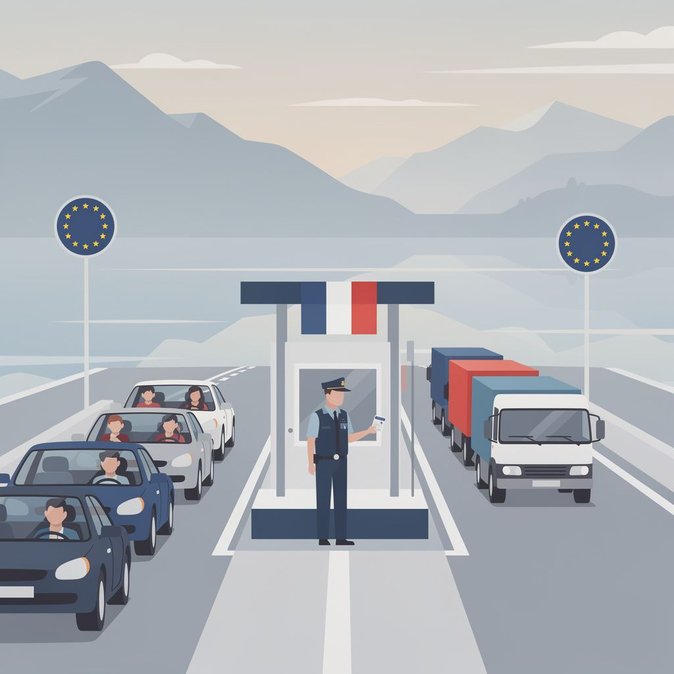
France woke up on 15 June 2026 to a transformed European migration landscape. At 00:00, the ten-law Migration & Asylum Pact adopted in 2024 became fully applicable across the EU, replacing the Dublin-based rules that had long strained front-line member states. For France, the change is immediately tangible: every irregular arrival at the external Schengen border—including the country’s overseas territories—must now be registered within seven days, undergo biometric checks, and receive a rapid security and health screening. The goal is to ensure that people who are unlikely to obtain protection, or who pose a risk, never pass unrecorded into the Schengen area. Paris has spent the last two years rewriting domestic regulations to dovetail with the pact. A June 6 French decree aligned the Code de l’Entrée et du Séjour des Étrangers et du Droit d’Asile with the EU text, setting strict timetables for the Office français de l’immigration et de l’intégration (OFII) to process cases. Under the new regime, asylum claims judged “manifestly unfounded” may be rejected within 12 weeks, while successful applicants will benefit from harmonised reception standards—legal aid, vocational support, and integration courses—defined at EU level. For companies moving talent into France, the pact’s most immediate impact will be predictability at the border. Uniform screening rules should reduce the risk of ad-hoc police checks that have occasionally delayed executives carrying third-country passports when transiting through Paris-Charles-de-Gaulle. Employers should, however, prepare for stricter enforcement against overstays and secondary movements inside Schengen: Eurodac’s beefed-up biometrics will make it harder for assignees to “reset” their visa clock by briefly exiting the bloc. Migration professionals also highlight the new mandatory “solidarity mechanism.” If France faces a sudden surge in maritime arrivals in its Atlantic or Mediterranean zones, other EU members will have to offer relocation places or financial support. Conversely, French taxpayers will contribute when pressure shifts to Italy, Greece or Spain—costs the finance ministry is already modelling into its 2027 budget. Practically, HR teams should review mobility policies: employees entering on short-stay visas will see no change, but posted workers holding temporary residence permits may face additional exit/entry scans each time they cross Schengen’s external border. Providing them with up-to-date travel letters and ensuring they carry biometric passports will help them clear the new automated kiosks swiftly.
Source: EU Reporter