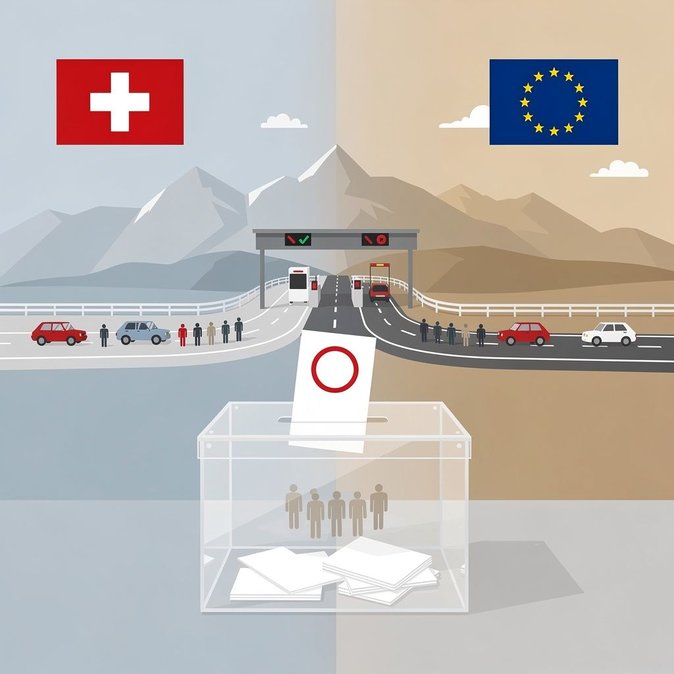
Brussels wasted no time reacting to Sunday’s referendum in which 54.8 % of Swiss voters said ‘No’ to a constitutional population ceiling of ten million residents by 2050. Speaking on 15 June, European Commission President Ursula von der Leyen called the result “a strong signal that Switzerland remains committed to openness and our shared economic space.” Her comments, reported by Swissinfo the same morning, suggest new momentum for negotiations on an updated package of bilateral accords that had stalled over freedom-of-movement sensitivities. The defeated initiative—championed by the nationalist Swiss People’s Party—would have forced Bern to renegotiate free-movement rules with the EU each time population forecasts surpassed interim thresholds. Business associations, cantonal governments and the Federal Council warned that such trigger clauses threatened Switzerland’s privileged access to the single market, its cross-border workforce of 370 000 commuters and the seamless posting of staff across Europe. For global-mobility professionals, the referendum result removes an immediate risk of quota-style uncertainty that would have complicated intra-company transfers, project staffing and client visits. Cross-border commuters—vital to the pharmaceutical clusters around Basel and the financial centre of Geneva—can continue to rely on the existing residence-and-work-permit framework. Yet the relatively high 45 % ‘Yes’ share underscores persistent unease about migration pressures, housing costs and infrastructure strain. Observers expect the government to unveil counter-measures, possibly tightening family-reunification criteria or accelerating deportations of rejected asylum seekers. Companies should therefore stay alert to incremental policy tweaks even without a constitutional mandate. The EU’s warm reception may also speed up the resumption of talks on Switzerland’s association to the Horizon Europe research programme—a key draw for multinational R&D centres—as well as on electricity market integration. Mobility managers should watch these dossiers, which influence where firms base talent-intensive units and how easily staff can be seconded between Swiss and EU entities.
Source: SWI swissinfo.ch