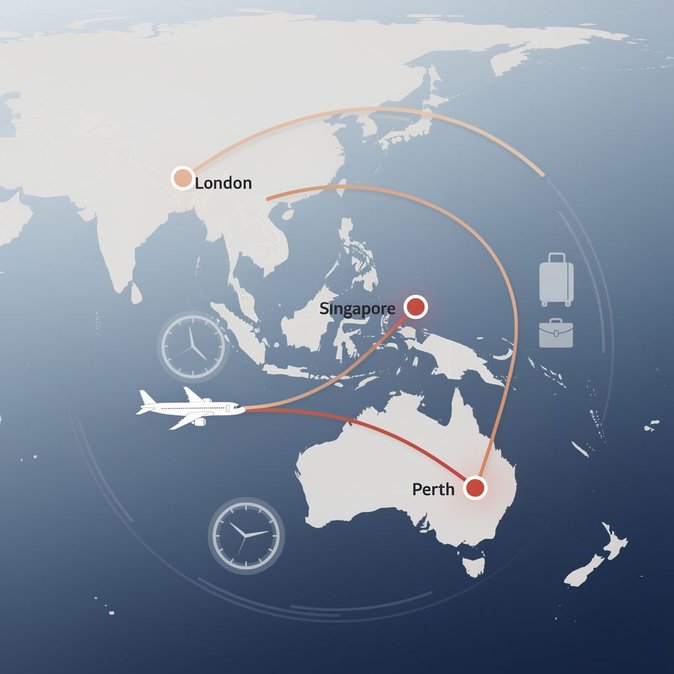
Eight years after trumpeting the first ever non-stop link between Australia and Europe, Qantas has quietly shelved the westbound leg of its flagship PER–LHR service, re-routing it through Singapore effective 16 June 2026. The airline now sells the flight as QF209 (Perth–Singapore–London) while maintaining the non-stop eastbound London–Perth sector (QF10). The change was triggered by Middle-East airspace closures that lengthened the great-circle track beyond the practical range of the Boeing 787-9 at full payload. By refuelling in Singapore, Qantas can lift long-standing seat-cap restrictions, adding more than 60 revenue passengers per departure and improving cargo uplift—but at the price of a journey now topping 20 hours westbound.
For corporate travel managers the impact is immediate. Perth-based executives heading to Europe lose the time-saving edge that once justified a fare premium, and duty-of-care policies may need updating to reflect longer crew-duty and passenger-fatigue windows. Travellers with onward connections in Heathrow’s morning bank should review itineraries; arrival is now in the early afternoon. The reroute also removes any competitive gap with Gulf carriers, reopening opportunities to shop around for one-stop fares via Dubai, Doha or Abu Dhabi.
Qantas has filed the detour through at least mid-July but has not given a reinstatement date. Aviation analysts note that keeping the Singapore stop indefinitely could become commercially attractive if airspace restrictions persist, because higher load factors offset the cost of the extra sector.
Travel and HR teams looking for a one-stop resource to confirm whether staff need a transit visa for Singapore—or a Schengen or UK entry visa for onward travel—can turn to VisaHQ. The Australia-based portal (https://www.visahq.com/australia/) aggregates the latest requirements for more than 200 jurisdictions and offers end-to-end application processing, giving companies and travellers a streamlined way to stay compliant amid shifting route patterns.
The airline is already marketing through-check of baggage and boarding passes to smooth the technical stop. Visa implications are minimal—passengers remain in transit—but mobility teams should confirm that staff holding limited-passport categories are eligible for Singapore’s 24-hour visa-free transit facility. Those electing longer lay-overs to break the trip will need to satisfy Singapore’s standard entry rules, including proof of onward travel and, for some nationalities, an entry visa.
For corporate travel managers the impact is immediate. Perth-based executives heading to Europe lose the time-saving edge that once justified a fare premium, and duty-of-care policies may need updating to reflect longer crew-duty and passenger-fatigue windows. Travellers with onward connections in Heathrow’s morning bank should review itineraries; arrival is now in the early afternoon. The reroute also removes any competitive gap with Gulf carriers, reopening opportunities to shop around for one-stop fares via Dubai, Doha or Abu Dhabi.
Qantas has filed the detour through at least mid-July but has not given a reinstatement date. Aviation analysts note that keeping the Singapore stop indefinitely could become commercially attractive if airspace restrictions persist, because higher load factors offset the cost of the extra sector.
Travel and HR teams looking for a one-stop resource to confirm whether staff need a transit visa for Singapore—or a Schengen or UK entry visa for onward travel—can turn to VisaHQ. The Australia-based portal (https://www.visahq.com/australia/) aggregates the latest requirements for more than 200 jurisdictions and offers end-to-end application processing, giving companies and travellers a streamlined way to stay compliant amid shifting route patterns.
The airline is already marketing through-check of baggage and boarding passes to smooth the technical stop. Visa implications are minimal—passengers remain in transit—but mobility teams should confirm that staff holding limited-passport categories are eligible for Singapore’s 24-hour visa-free transit facility. Those electing longer lay-overs to break the trip will need to satisfy Singapore’s standard entry rules, including proof of onward travel and, for some nationalities, an entry visa.